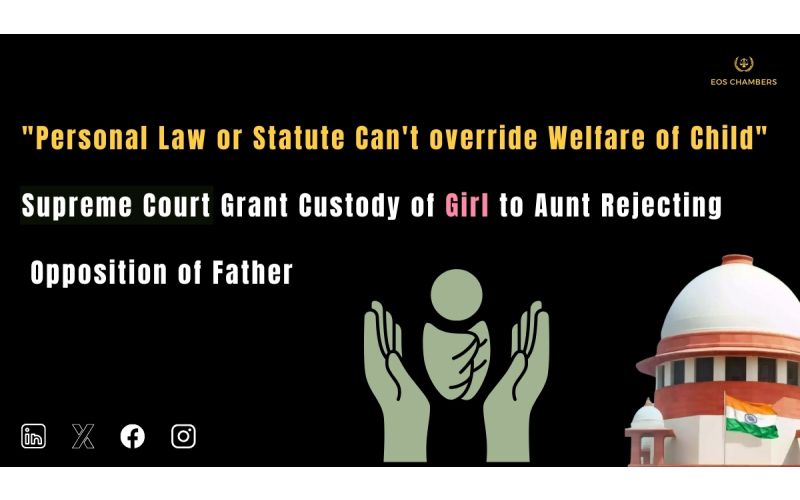
The Supreme Court, while granting custody of a minor child to the her aunt despite opposition from the father, held that the personal law or statute couldn't override the welfare of the child while deciding the custody of the child.
“In view of our aforesaid discussions, we find that the welfare of the child lies with her custody with the appellants and respondent No. 10 (aunt). This is coupled with the fact that even she also wishes to live there. Keeping in view her age at present, she is capable of forming an opinion in that regard. She was quite categoric in that regard when we interacted with her. She cannot be treated as a chattel at the age of 14 years to hand over her custody to the respondent No.2 (minor's biological father), where she has not lived ever since her birth. Stability of the child is also of paramount consideration.”, the Bench Comprising Justices C.T. Ravikumar and Rajesh Bindal Said.
The aforesaid observation in the Judgment authored by Justice Rajesh Bindal came after noting that the minor had been living in the custody of relatives/appellants when she was 3-4 months old after the biological father requested them to take care of the minor.
Background
The undisputed facts on record are that twins were born to respondent No. 2 and his wife (biological parents of a minor child). One of them, the custody of whom is in question, has undisputedly been living with appellant No. 2 (sister of respondent no.2 ) ever since she was 3-4 months old and thereafter with the family. Presently, she is about 14 years of age.
It is not a case in which any of the parties is claiming adoption which otherwise is not permissible under Mohammedan law. Guardianship is also not being claimed. It is only the dispute regarding custody of the child.
In 2021, the father filed a habeas corpus petition before the Orissa High Court seeking custody of the child. In 2023, the High Court allowed the petition , directing the restoration of the child to the father. Challenging this order, the aunt approached the Supreme Court. In June 2023, the Supreme Court had stayed the High Court's order.
Before the Supreme Court, it was contended by respondent no.1/biological father that the custody of the minor child cannot be vested in the relative/appellant no.2 as Muslim law prohibits custody amongst the stranger to the family. It was alleged by the biological father that appellant No. 2 is married to a stranger therefore, the custody cannot be vested with her because in terms of Mohammedan law, custody of the child cannot be given to the stranger, who is beyond prohibitory degree for marriage.
Supreme Court's Observation
Rejecting such contention of respondent no.1/biological father, the Supreme Court observed that the question of custody is different from guardianship, therefore the paramount consideration should be given to the welfare of the child while deciding the question of the child's custody.
“The statutory provisions dealing with the custody of the child under any personal law cannot and must not supersede the paramount consideration as to what is conducive to the welfare of the minor. In fact, no statute on the subject, can ignore, eschew or obliterate the vital factor of the welfare of the minor.”, the Supreme Court said in and was referred by the Supreme Court in the present case.
“This Court in Roxann Sharma v. Arun Sharma , opined that the child is not a chattel or ball that it is bounced to and fro. Welfare of the child is the focal point.”, the court said.
The court further noted the best interest of the child by taking reference to the child's wish, if she is capable of understanding her welfare.
“In the case in hand, vide order dated 12.12.2023, we had called the child in Court. We had interacted with the child, the appellants and respondent No. 2 individually in chamber. We found the child to be quite intelligent, who could understand her welfare. She categorically stated that she is happy with the family where she has been brought up. She has other brother and sister. She is having cordial relations with them. She does not wish to be destabilized.”, the court recorded.
The Supreme Court also distinguished the judgment of Tejaswani Gaud v. Shekhar Jagdish Prasad Tewari, relied upon by the respondent no.1/biological father to contend that if the child comes back, she will also have love, affection and company of her twin sister and the biological parents would take care of her child. However, the court observed that “the judgment relied upon by the respondent No. 2 does not come to her rescue for the reason that age of the child in that case was merely five years. It is a case which lays down guidelines as to how custody of the child is to be handed over.”
Ultimately, the Supreme Court allowed the appeal, and granted the custody of the minor child to the relative/appellants after founding that “the best interest of the child still remains with the appellant No. 2 as the child is living with her ever since she was 3-4 months old and is now about 14 years of age having no doubt in her mind that she wishes to live with them.”
“the best interest of the child still remains with the appellant No. 2 as the child is living with her ever since she was 3-4 months old and is now about 14 years of age having no doubt in her mind that she wishes to live with them.”
Counsels For Petitioner(s) Mr. Amit Pawan, AOR Mr. Anand Nandan, Adv. Mr. Abhishek Amritanshu, Adv. Mr. Aakarsh, Adv. Mr. Hassan Zubar Waris, Adv. Mr. S.S. Rawat, Adv. Ms. Shivangi, Adv.