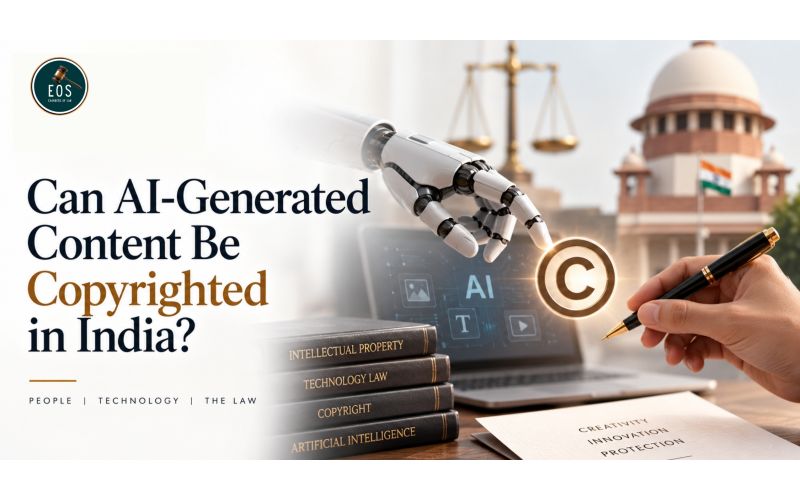
Understanding Copyright Ownership, AI-Assisted Creation, Originality and the Emerging Legal Position
Artificial Intelligence has fundamentally changed the way content is created.
Today, a person can use an AI tool to generate a blog article, photograph, illustration, advertisement, music composition, video, presentation, software code or other creative material within minutes.
This creates an important legal question:
If Artificial Intelligence creates the content, who owns the copyright in that content?
The answer under Indian law is not simply that “AI owns the copyright” or that “AI-generated content can never be copyrighted.”
India's Copyright Act, 1957 already contains a provision dealing with computer-generated works. However, the application of that provision to modern generative AI raises questions that Indian courts have not yet comprehensively settled.
The most important issue is therefore not merely whether AI was used, but what role the human played in creating the final work.
The Short Answer
Under Indian law, copyright protection can potentially exist in a computer-generated work, because Section 2(d)(vi) of the Copyright Act, 1957 recognises, in relation to a computer-generated literary, dramatic, musical or artistic work, the person who causes the work to be created as the “author.”
However, this does not automatically mean that every output generated by entering a simple prompt into an AI system will receive copyright protection.
Section 13 requires copyright to subsist in original literary, dramatic, musical and artistic works. The Supreme Court has also emphasised that originality requires more than merely mechanical effort and involves an element of creativity.
Therefore, the stronger legal position is:
AI-assisted work with meaningful human creative contribution is more likely to present a stronger copyright claim than purely autonomous AI output with little or no human creative input.
But Indian law has not yet produced a definitive Supreme Court ruling establishing a universal test specifically for generative-AI output.
1. What Does the Indian Copyright Act Say About AI?
Interestingly, the Copyright Act, 1957 predates today's generative AI revolution by decades.
Yet the legislation contains language that is particularly relevant to computer-generated works.
Section 2(d)(vi) provides that, in relation to a literary, dramatic, musical or artistic work which is computer-generated, the author is “the person who causes the work to be created.”
This provision is important because Indian copyright law does not expressly require the author of such a computer-generated work to be the computer itself.
Instead, the statute identifies a person as the author.
This creates a possible statutory pathway for ownership of certain AI-generated works.
However, there is an important qualification.
The work must still satisfy the requirements for copyright protection, including originality.
2. What Is “Originality” Under Indian Copyright Law?
Copyright does not protect every piece of information, idea or output.
The Copyright Office explains that copyright protects original expression, rather than ideas, concepts or facts.
The Supreme Court's decision in Eastern Book Company v. D.B. Modak is particularly important in understanding the Indian originality standard.
The Court explained that originality requires independent creation and at least a minimal degree of creativity. Mere labour or mechanical effort, by itself, is not necessarily sufficient.
This principle becomes extremely important when AI is involved.
Consider two situations.
Situation A — Minimal Human Input
A person enters:
“Write a 1,000-word article about Indian contract law.”
The AI generates the entire article.
The person makes no meaningful creative changes and publishes it.
The copyright position here is far less certain.
Situation B — Substantial Human Creative Input
A lawyer:
- develops the legal argument;
- determines the structure;
- provides original research;
- supplies factual material;
- gives detailed instructions;
- generates multiple drafts;
- selects particular passages;
- substantially rewrites the output;
- adds original analysis;
- reorganises the material; and
- exercises creative judgment over the final version.
The resulting work contains identifiable human intellectual contribution.
The copyright position is considerably stronger.
3. Does the AI Become the “Author”?
No.
The Copyright Act does not recognise an AI system as the author under Section 2(d)(vi).
The statutory language identifies the person who causes the computer-generated work to be created as the author.
The Copyright Office's own handbook similarly states that, for a computer-generated work, the author is the person who causes the work to be created.
Therefore, the legal question shifts from:
“Does the AI own the work?”
to:
“Who is the human person who caused the work to be created, and what was that person's contribution?”
That distinction could become extremely important in future copyright disputes involving generative AI.
4. Is a Prompt Enough to Establish Copyright?
This is one of the most difficult questions.
There is currently no definitive Supreme Court ruling in India establishing that entering a prompt alone automatically makes the user the copyright owner of the resulting AI output.
A prompt can range from a very simple instruction to an extremely detailed creative direction.
For example:
“Create a picture of a lawyer.”
This is a relatively generic instruction.
Compare it with:
“Create a cinematic editorial illustration showing an Indian courtroom at sunrise, with a senior advocate standing before the Bench, specific composition, lighting, architectural elements, visual symbolism and a particular narrative mood.”
The second instruction involves considerably more creative direction.
But even then, the legal question does not end with the prompt.
The court may potentially have to examine:
- the nature of the instructions;
- the user's creative decisions;
- the interaction with the AI system;
- selection among multiple outputs;
- modifications made by the user;
- arrangement and composition;
- post-processing;
- editing;
- human-authored elements; and
- the final form in which the work was published.
Thus, the more substantial and demonstrable the human creative contribution, the stronger the argument for human authorship and copyright protection.
5. What About AI-Assisted Content?
This is perhaps the most commercially important category.
There is a major difference between:
AI-generated content
and
AI-assisted human-created content.
Suppose an author writes a 5,000-word article but uses AI to:
- improve grammar;
- suggest headings;
- reorganise paragraphs;
- generate alternative wording;
- identify inconsistencies;
- assist with research;
- create a preliminary draft.
The final article may still contain substantial human authorship.
In such a case, AI is functioning more like a creative or productivity tool rather than independently replacing the human creator.
Copyright law traditionally focuses on the protected expression and the author's contribution. India's originality jurisprudence therefore provides a useful framework for analysing AI-assisted works.
6. What Happens When a Human Heavily Edits AI Output?
This is another important distinction.
Imagine that an AI system generates a 2,000-word article.
The user then:
- rewrites 60–70% of it;
- introduces original legal analysis;
- adds original examples;
- restructures the arguments;
- verifies authorities;
- changes the narrative;
- adds original commentary; and
- creates the final presentation.
The final work may contain substantial human-authored expression.
The copyright claim may therefore be directed toward the human-created elements and the overall original expression, subject to the facts of the particular case.
This is consistent with the broader Indian principle that copyright protects original expression rather than ideas themselves.
7. Can AI-Generated Images Be Copyrighted in India?
The same basic question applies to AI-generated artistic works.
Section 2(d)(vi) expressly covers computer-generated artistic works.
However, the originality requirement remains relevant.
For example:
Pure AI Output
A user enters one short prompt and downloads the first image produced by the system without modification.
The copyright position may be uncertain.
Human-Curated AI Artwork
A creator:
- develops the concept;
- generates dozens of alternatives;
- selects particular compositions;
- modifies the prompt repeatedly;
- combines AI-generated elements;
- digitally edits the image;
- changes lighting and composition;
- adds original graphical elements; and
- produces the final artwork.
The human contribution becomes much more significant.
That distinction could become important when determining whether copyright exists and, if so, which elements are actually protected.
8. What About AI-Generated Music and Videos?
The same legal principles can potentially extend to:
- AI-generated music;
- AI-assisted songs;
- AI-generated videos;
- AI-assisted films;
- synthetic voices;
- AI-generated illustrations;
- advertisements;
- computer-generated literary works; and
- other creative outputs falling within recognised categories of copyright works.
But different rights may exist within the same production.
For example, an AI-assisted video may contain:
- screenplay;
- music;
- photographs;
- performances;
- voice recordings;
- graphics;
- trademarks; and
- other protected works.
Copyright ownership of the final video does not automatically give the creator ownership of every underlying element.
This is a crucial point for businesses using generative AI commercially.
9. Copyright Ownership Is Not the Same as Permission to Use
Suppose an AI tool generates an image resembling a famous actor.
Even if someone claims copyright in the resulting image, that does not automatically mean the person has permission to commercially exploit the actor's identity, likeness or persona.
Indian courts have increasingly dealt with unauthorised AI-generated content involving personality and publicity rights.
For example, in 2026, the Delhi High Court granted protection against unauthorised AI-generated content involving public figures in several cases, including matters concerning Mohanlal, Sonakshi Sinha, Arjun Kapoor, Allu Arjun and Aman Gupta.
This demonstrates an important legal distinction:
Copyright is only one part of the legal analysis surrounding AI-generated content.
Other legal issues can include:
- personality rights;
- privacy;
- trademark infringement;
- passing off;
- defamation;
- contractual restrictions;
- confidentiality;
- data protection; and
- infringement of third-party copyright.
10. Can AI-Generated Content Infringe Someone Else's Copyright?
Yes, potentially.
The fact that an AI system created the output does not automatically provide a defence against copyright infringement.
For example, if an AI-generated output substantially reproduces protected material belonging to another person, the use may raise copyright concerns depending upon the facts and applicable exceptions.
This is particularly important for businesses using AI-generated:
- marketing material;
- images;
- product designs;
- articles;
- music;
- advertisements;
- software; or
- video content.
Companies should therefore avoid assuming:
“AI created it, so there cannot be copyright infringement.”
That assumption can be legally risky.
11. The Important 2026 Development: ANI v. OpenAI
The Indian legal position around AI and copyright has moved significantly in 2026 because of the litigation between Asian News International (ANI) and OpenAI.
In ANI Media Pvt. Ltd. v. OpenAI Inc. & Anr., the Delhi High Court considered allegations concerning the use of ANI's copyrighted works in connection with AI training and the generation of outputs.
On 24 July 2026, Justice Amit Bansal declined ANI's application for interim injunction. At the interim stage, the Court took the prima facie view that OpenAI's storage of ANI's works for the purposes considered in the case fell within Section 52(1)(a), and that the outputs demonstrated before the Court were not substantially similar to ANI's works.
Importantly, this case concerns AI training, use of copyrighted input material and alleged reproduction in outputs.
It is not a final Supreme Court ruling deciding that all AI-generated content is copyrightable.
Nor does it definitively resolve every issue concerning AI authorship.
The case is therefore highly relevant to the developing legal landscape, but its findings should be understood in their proper procedural and factual context.
As of September 2026, ANI has challenged the rejection of its interim relief before the Delhi High Court's Division Bench, with the appeal listed for hearing on 14 September 2026.
12. Why the ANI Case Matters to Businesses
The case illustrates that AI copyright disputes can involve at least two separate questions:
Input
Can copyrighted material be used to train an AI model without permission?
Output
Does the AI-generated response reproduce or substantially reproduce protected copyrighted expression?
These are legally different questions.
A business using generative AI should therefore consider both.
13. What Does “Person Who Causes the Work to Be Created” Actually Mean?
This phrase in Section 2(d)(vi) is likely to become one of the most important provisions in future Indian AI copyright litigation.
The provision was drafted long before today's sophisticated generative AI systems.
A modern AI workflow may involve:
Human → Prompt → AI Model → Multiple Outputs → Human Selection → Editing → Final Work
Who exactly “caused” the final work to be created?
Possible candidates could include:
- the person entering the prompt;
- the person designing the creative instructions;
- the person selecting the output;
- the person substantially editing it;
- an employer or commissioning entity;
- or potentially a combination of contractual and statutory considerations.
Indian courts may ultimately need to interpret Section 2(d)(vi) in the context of modern generative AI.
Until then, businesses should avoid treating the provision as an automatic answer to every AI ownership dispute.
14. What Should Businesses Do When Using AI?
Businesses using AI for commercial content should adopt a basic AI copyright compliance process.
1. Maintain records
Keep records of:
- prompts;
- drafts;
- human edits;
- source material;
- approvals;
- final versions; and
- relevant AI-tool terms.
2. Document human contribution
Where copyright ownership matters, maintain evidence showing the human creative contribution.
3. Review third-party material
Do not assume that AI-generated material is automatically free from third-party rights.
4. Review the AI platform's terms
Commercial rights and licensing terms can differ between AI platforms and plans.
5. Avoid unauthorised use of identifiable persons
AI-generated images or videos involving real people may create personality-rights, privacy, trademark or defamation issues.
6. Conduct legal review for high-value content
Particularly for:
- advertising campaigns;
- films;
- books;
- commercial artwork;
- software;
- branded content;
- legal publications;
- news content; and
- high-value intellectual property.
15. Can AI Content Be Registered With the Copyright Office?
Copyright registration is not what creates copyright in the first place.
The Copyright Office explains that copyright generally comes into existence automatically when the work is created, although registration can provide evidentiary advantages because registration entries can serve as prima facie evidence in disputes.
However, registration of AI-generated material can raise questions about:
- who the author is;
- what human contribution was made;
- whether the work is original;
- what portion of the work is claimed;
- and how the application describes the creation process.
Therefore, anyone seeking registration of an AI-assisted work should ensure that the application accurately reflects the circumstances of creation.
A false or incomplete description of authorship can create problems later.
16. AI Does Not Automatically Destroy Copyright
There is a tendency to think:
“If AI was involved, there is no copyright.”
That is too broad.
Indian law already recognises computer-generated works through Section 2(d)(vi).
The more accurate approach is to ask:
What did the human contribute?
If the final work contains substantial original human expression, there is a stronger basis for copyright protection in those human-created elements.
Conversely, where the output is generated with little meaningful human creative involvement, the scope and strength of copyright protection become more uncertain.
17. The Real Legal Test May Be Human Creativity
Indian copyright jurisprudence already places considerable importance on originality and creativity.
In Eastern Book Company v. D.B. Modak, the Supreme Court rejected the idea that mere labour and investment automatically establish copyright and emphasised independent creation and a minimum level of creativity.
This principle may become highly significant when courts examine generative AI.
The future question may not be:
“Was AI used?”
Instead, it may be:
“What original intellectual and creative contribution did the human author make to the final work?”
That is likely to be the more meaningful inquiry.
18. What Does This Mean for Lawyers, Creators and Businesses?
For lawyers, AI can assist with research, drafting and organisation, but professional responsibility remains human.
For authors and publishers, maintaining evidence of original human contribution can become increasingly important.
For advertising agencies, AI-generated images and videos should undergo rights clearance before commercial use.
For technology companies, AI development requires careful assessment of training data, licensing and output-related risks.
For businesses, AI policies should address intellectual property ownership, confidentiality, data handling and third-party rights.
And for content creators, AI should ideally be treated as a tool within a broader creative process rather than as a substitute for documenting authorship.
19. Frequently Asked Questions
Can AI-generated content be copyrighted in India?
Potentially, yes. Section 2(d)(vi) recognises the person who causes a computer-generated literary, dramatic, musical or artistic work to be created as its author. However, the work must still satisfy the requirements of copyright protection, including originality.
Does AI itself own copyright?
Indian copyright law does not recognise AI as the author under Section 2(d)(vi). The statute identifies a person as the author of a computer-generated work.
Is a simple AI prompt enough to get copyright?
There is no definitive Indian Supreme Court ruling establishing that a simple prompt automatically gives the user copyright in the resulting output. The extent of human creative contribution is likely to be important.
Can AI-generated images be copyrighted?
Potentially, depending upon the nature of the work, originality and human contribution. Section 2(d)(vi) expressly refers to computer-generated artistic works.
Can AI-generated content infringe copyright?
Yes. AI involvement does not automatically eliminate potential infringement of third-party copyrighted material.
Do I need copyright registration?
Copyright generally arises automatically upon creation of a qualifying work. Registration is not mandatory, but registration records can have evidentiary value in disputes.
Is AI-assisted content different from purely AI-generated content?
Yes. Where a human contributes substantial original expression, editing, selection, arrangement or creative decisions, the copyright position can be materially different from a work produced almost entirely autonomously by an AI system.
Conclusion
Artificial Intelligence is forcing copyright law to confront a question that did not exist in its present form when the Copyright Act, 1957 was enacted.
India, however, is not starting from zero.
Section 2(d)(vi) already recognises computer-generated works and identifies the person who causes such a work to be created as the author. At the same time, Section 13 and Indian judicial precedent require copyrightable works to satisfy the requirement of originality.
The difficult question is therefore not simply whether AI-generated content is copyrightable.
It is:
Where does human creativity end and machine generation begin—and how much human contribution is sufficient to create a protectable work?
Indian courts are likely to confront this question with increasing frequency as generative AI becomes part of everyday commercial and creative activity.
For now, the safest approach for creators and businesses is to document human creative involvement, maintain records of the creation process, review third-party rights, and avoid assuming that every AI output is automatically protected—or automatically free to use.
The future of copyright in India may not be AI versus humans.
It may instead be about defining the legal relationship between human creativity and machine-assisted creation.