
India's Tougher Anti-Paper Leak Law-A Step Towards Protectin
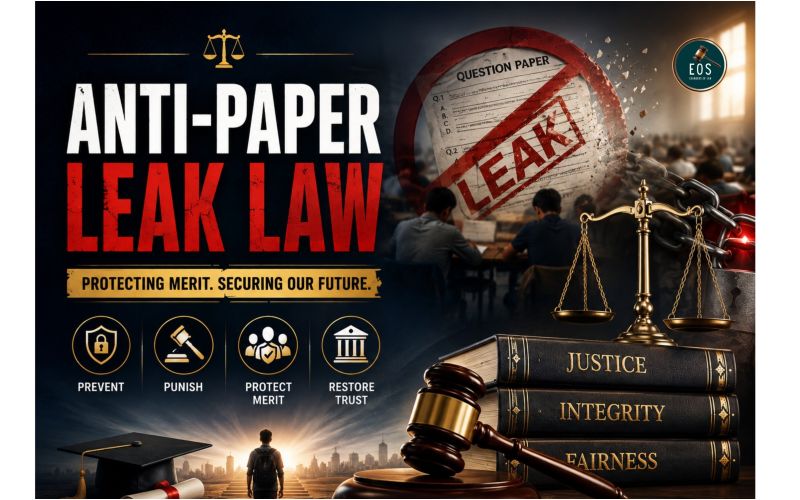
India's Tougher Anti-Paper Leak Law-A Step Towards Protecting Merit and Restoring Public Trust
|
A Legal Perspective on the Public Examinations (Prevention of Unfair Means) Amendment Act, 2026
For millions of students across India, a public examination is far more than a test—it represents years of dedication, family sacrifices, and aspirations for a better future.
When the integrity of such examinations is compromised through paper leaks or organized cheating, the consequences extend well beyond a single examination. They undermine public confidence, weaken meritocracy, and challenge the very principles of fairness upon which a democratic society is built.
Recognizing the growing concern over recurring examination malpractices, Parliament has strengthened the legal framework through the Public Examinations (Prevention of Unfair Means) Amendment Act, 2026, introducing stricter penalties, faster investigations, and specialized mechanisms to combat organized examination fraud.
Why Was a Stronger Law Needed?
In recent years, India witnessed several controversies involving alleged paper leaks in competitive and recruitment examinations. These incidents not only delayed recruitment and admissions but also deeply affected the confidence of lakhs of deserving candidates.
A single paper leak has consequences that extend beyond the examination hall.
It affects:
- Students who prepare for years.
- Families who invest significant financial resources.
- Educational institutions.
- Public recruitment processes.
- Society's confidence in equal opportunity.
Merit loses its meaning when unfair means replace honest effort.
What Does the Amendment Aim to Achieve?
The 2026 Amendment strengthens the Public Examinations (Prevention of Unfair Means) Act, 2024 by introducing a more robust enforcement mechanism against organized examination fraud.
Its objectives include:
- Protecting the integrity of public examinations.
- Deterring organized paper leak syndicates.
- Ensuring time-bound investigation.
- Providing speedy trials through Special Fast Track Courts.
- Restoring public confidence in examination systems.
The legislation recognizes that examination fraud is no longer an isolated misconduct but often involves organized networks using technology and financial incentives.
Key Legal Changes
The Amendment introduces several significant reforms.
1. Enhanced Punishments
The law substantially increases imprisonment terms and financial penalties for individuals, service providers, and organized criminal networks involved in examination fraud. In serious organized crime cases, the minimum punishment has been increased, accompanied by significantly higher fines.
2. Fast-Track Investigation and Trial
One of the most notable features is the introduction of:
- Time-bound investigations,
- Special Fast Track Courts,
- Special Public Prosecutors,
- Expedited appeals.
The objective is to ensure that examination-related offenses are resolved without prolonged litigation, thereby strengthening deterrence.
3. Stronger Action Against Organized Crime
The amendment targets not merely individual offenders but also organized networks, institutions, and service providers involved in facilitating unfair means.
This reflects an important shift from punishing isolated misconduct to dismantling organized examination fraud.
Constitutional Perspective
The Constitution of India guarantees equality before law under Article 14 and protects the right to life and personal liberty under Article 21, which has been judicially interpreted to include fairness in State action.
Public examinations conducted by government authorities must therefore satisfy constitutional standards of:
- fairness,
- transparency,
- equal opportunity, and
- non-arbitrariness.
When examination integrity is compromised, it directly impacts these constitutional values.
Protecting merit is not merely an administrative objective—it is a constitutional obligation.
Will Stricter Punishments Alone Solve the Problem?
Stronger penalties undoubtedly enhance deterrence.
However, sustainable reform requires more than criminal sanctions.
Long-term improvement also depends upon:
- Secure digital examination infrastructure.
- Robust cybersecurity.
- Greater institutional accountability.
- Advanced monitoring systems.
- Transparent examination processes.
- Regular audits of examination authorities.
Law can punish misconduct.
Good governance prevents it.
Restoring Public Confidence
The greatest objective of this legislation is not merely increasing punishments.
It is restoring public trust.
Students should enter examination halls with confidence that:
- every candidate competes fairly,
- merit alone determines success,
- the system rewards honest effort,
- and opportunities cannot be purchased through organized malpractice.
A credible examination system strengthens confidence not only in education but also in public institutions.
The Way Forward
India's education and recruitment systems continue to evolve alongside technological advancements.
The 2026 Amendment represents a significant legislative response to one of the most pressing challenges confronting public examinations.
Its success, however, will ultimately depend upon effective implementation, institutional vigilance, technological safeguards, and strict enforcement of the law.
A robust legal framework is an important beginning.
Consistent execution will determine its lasting impact.
Conclusion
Education remains one of the most powerful instruments of social mobility.
Every deserving student has the right to compete in an environment governed by fairness, transparency, and merit.
The Public Examinations (Prevention of Unfair Means) Amendment Act, 2026 sends a strong message that organized examination fraud will not be tolerated and that the integrity of public examinations is a matter of national importance.
As India continues to strengthen its education and recruitment systems, one principle must remain unwavering:
The credibility of a nation's future depends upon the integrity of its examinations.
Post Categories
Featured Posts




Latest Posts








Latest Posts

How to Legally Protect Your Business in India: A Complete Compliance Checklist (2026)
In today’s rapidly evolving regulatory environment, running a business in India is not just about growth—it is about staying compliant, protected, and risk-aware. Many businesses face legal challenges not due to intent, but due to lack of structured compliance systems. ...
S. 50 NDPS Act Not Applicable To Recovery From Bag Carried By A Person: Supreme Court
The Supreme Court recently reiterated that the conditions for personal search as specified in Section 50 of the Narcotic Drugs and Psychotropic Substances Act are applicable only for the search of the physical body of the person and not for ...
Stop Misleading Advertisements, Will Impose Rs 1 Crore Cost On Every Product Claiming False Cure: Supreme Court To Patanjali Ayurved
The Supreme Court on Tuesday (November 21) reprimanded the Patanjali Ayurved for continuing to publish misleading claims and advertisements against modern systems of medicine. While considering a petition filed by the Indian Medical Association against misleading advertisements, the bench comprising ...
CJI DY Chandrachud Cautions About Artificial Intelligence; Says It Can Make Biased Decisions Based On Societal Prejudices
Chief Justice of India D Y Chandrachudrecently spoke on how no technology is neutral and how it can reflect human values when deployed in the real world. The CJI spoke on how one must ponder the human and societal values ...

Permanent Establishment (PE) Risk for Foreign Companies in India – 2026 Compliance Alert
Introduction: Why PE Risk Is a Serious Compliance Issue in 2026 India continues to witness heightened scrutiny of foreign companies operating through subsidiaries, employees, consultants, and digital presence. With increased data sharing, GST intelligence, and income-tax investigations, Permanent Establishment (PE) ...

UAPA| Terrorism Cases Not To Be Taken Lightly: Supreme Court Sets Aside Default Bail
In a case pertaining to grant of default bail to a person accused under the Unlawful Activities (Prevention) Act, 1967 (“UAPA”), the Supreme Court yesterday allowed an appeal filed by the Delhi police, observing that the High Court fell in ...

Speak With Our
Get a Appointment