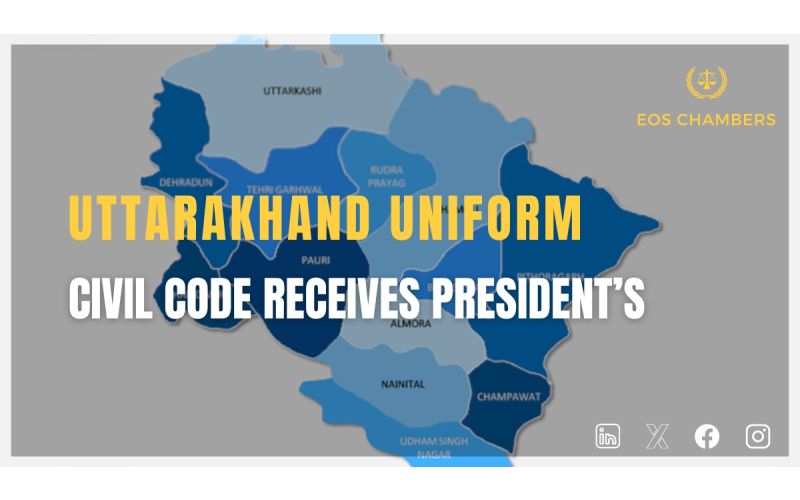
In a crucial development, the Uttarakhand Uniform Civil Code (UCC) Bill, 2024 has been granted assent by President of India Droupadi Murmu.
It may be recalled that in 2022, a committee was formed by Pushkar Singh Dhami-led Uttarakhand Government to prepare a draft of the UCC. This committee consisted of a five-member panel headed by retired Supreme Court Judge Ranjana Prakash Desai and submitted its report to the Chief Minister.
Two days after the the State Cabinet approved the final draft, the aforesaid Bill was tabled in the Uttarakhand Assembly (on February 6). It was passed the next day ie on February 7.
On February 28, the Bill was approved by the State Lieutenant Governor and reserved for President's assent.
Some key aspects of the law are: mandatory registration of live-In relations, conditions for a contract marriage, ban on halala, iddat and polygamy, and similar inheritance rights for men and women. It applies not only to Uttarakhand but also to residents of the State who are living outside its territories. The application to Scheduled Tribes, however, is excluded.
One of the most significant changes set out in the Act is mandatory registration of live-in relationships. Unprecedented to Indian law, persons who are part of live-in relationships (being Uttarakhand residents) are now required to register before a Registrar within one month of "entering the relationship”. On failure to do so, a jail sentence, or fine, or both may be awarded.
The state government is expected to soon issue a notification towards the implementation of the law.

The Supreme Court on Tuesday (October 31) asked the Governments of Punjab, Haryana, Uttar Pradesh, Rajasthan and Delhi to file affidavits setting forth the steps they have taken to control air pollution including the measures to curb crop burning. This ...
For Non-Resident Indians (NRIs), repatriating funds and investments back to their country of residence is a crucial aspect of financial management. However, navigating the legal landscape can be complex. Here are essential guidelines NRIs should follow to ensure smooth and ...
The Delhi High Court on Wednesday asked the Central Administrative Tribunal to decide expeditiously the Plea seeking reduction in the cut off from 33% to 23% for qualifying Part II (CSAT) exam of 2023 Civil Services Examination conducted by UPSC ...
Index: Introduction Understanding Criminal Offences 2.1 Petty Offences 2.2 Cognizable Offences 2.3 Non-Cognizable Offences Consequences of Criminal Offences 3.1 Legal Consequences 3.2 Social and Personal Impact 3.3 Societal Costs Conclusion———————————— Introduction: Criminal offenses encapsulate acts that transgress established laws and regulations, warranting punitive measures imposed ...
India’s judiciary is at a crossroads, with digitization and judicial reforms paving the way for increased efficiency, transparency, and accessibility. The e-Courts initiative, launched by the Indian judiciary under the National e-Governance Plan (NeGP), is a transformative step toward modernizing ...
Chief Justice of India DY Chandrachud announced today that the Supreme Court is officially 'onboard' with the National Judicial Data Grid (NJDG) now. The CJI described the onboarding of the Supreme Court data on NJDG portal under the court's 'open ...