
Supreme Court Says MP, MLA Can’t Claim Immunity From Prose
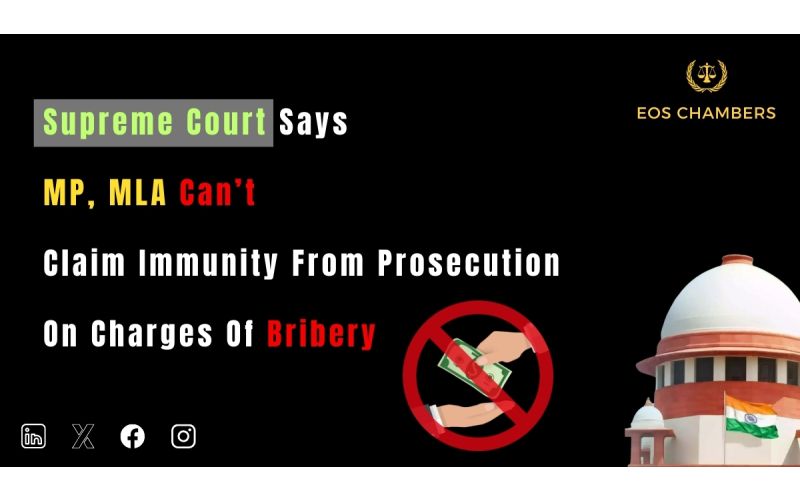
Supreme Court Says MP, MLA Can’t Claim Immunity From Prosecution On Charges Of Bribery
|
The seven-judge Constitution bench of the Supreme Court said it disagreed with the judgment in PV Narasimha and the judgment in PV Narasimha which grants immunity to legislators for allegedly bribery for casting a vote or speech has “wide ramifications and overruled”.
The Supreme Court’s seven-judge bench in its unanimous view overruled the 1998 PV Narasimha Roa judgment case which granted immunity to MPs/MLAs from prosecution to bribery for voting in Parliament.
While hearing the matter, the Chief Justice said, “We have independently adjudicated on all aspects of the controversy. Do Parliamentarians enjoy immunity? We disagree and overrule majority on this aspect.”
A bench of seven judges headed by the Chief Justice of India in October last year reserved the order after hearing the submissions. Other judges on the bench are Justices AS Bopanna, MM Sundresh, PS Narasimha, JB Pardiwala, Sanjay Kumar, and Manoj Misra.
Earlier, a five-judge bench referred the matter to a larger bench of seven judges to deal with the issues, observing that it was an important issue having a significant bearing on the morality of polity.
The court said that the purpose of Article 105(2) and Article 194(2) is to ensure that members of parliament and state legislatures are able to discharge duties in an atmosphere of freedom without fear of the consequences.
On March 7, 2019, a three-judge bench of the Supreme Court referred the matter to a larger bench, considering the wide ramifications of the question that has arisen. The court had then observed that the doubts raised and the issue being a matter of substantial public importance, the matter required to be considered by a larger bench.
The issue was raised while the court was hearing a petition filed by politician Sita Soren. Sita Soren has sought the criminal prosecution launched against her to be nullified on a claim of immunity under Article 194(2) of the Constitution of India.
The charges against Sita Soren were that she had allegedly accepted a bribe to vote in favour of a particular candidate in the Rajya Sabha election that was held sometime in 2012 in Jharkhand.
Post Categories
Featured Posts



Latest Posts








Latest Posts
Section 313 CrPC | 'Right To Remain Silent Not Be Used Against Accused' : Supreme Court Summarises 12 Principles
Recently, the Supreme Court, in a noteworthy judgment, while acquitting a woman accused of killing her own child and was convicted for murder and sentenced to life imprisonment, also decided the question of what may be required of the convict ...

'No right for queer couples to jointly adopt’: SC in same-sex marriage verdict
The CJI said the law didn't preclude unmarried couples from adopting.Chief Justice of India DY Chandrachud, while announcing his verdict on a clutch of petitions demanding legal status to same-sex marriages, today struck down the Central Adoption Resource Authority's (CARA) ...
AI & the Judiciary: Boundaries and Risks
🧠 Introduction: A New Era for Justice Artificial Intelligence (AI) has rapidly entered almost every professional domain — and the legal world is no exception. From predictive analytics to legal research automation, AI is revolutionizing how lawyers, judges, and courts ...
Cheque Bounce Case Can Be Quashed U/S 482 Only If Amount Is Patently Non-Recoverable; Whether Debt Time-Barred Or Not Is A Question Of Evidence : SC
The Supreme Court observed that the question whether a cheque was issued towards a time barred debt is to be decided on evidence. “It is only in cases wherein an amount which is out and out non-recoverable, towards which a ...
🤝 Mediation vs. Arbitration: Choosing the Right Path in ADR ⚖️
Alternative Dispute Resolution (ADR) has become an increasingly popular method for resolving disputes outside of traditional court litigation. Among the various ADR methods, mediation and arbitration stand out as two of the most commonly used approaches. While both aim to ...
The Role of Legal Technology in Modern Law Practices: Embracing the Digital Shift
In today’s rapidly evolving legal landscape, the integration of technology has become more than just a trend—it’s a fundamental shift that is reshaping how legal professionals operate and deliver services. As we embrace this digital transformation, the role of legal ...

Speak With Our
Get a Appointment