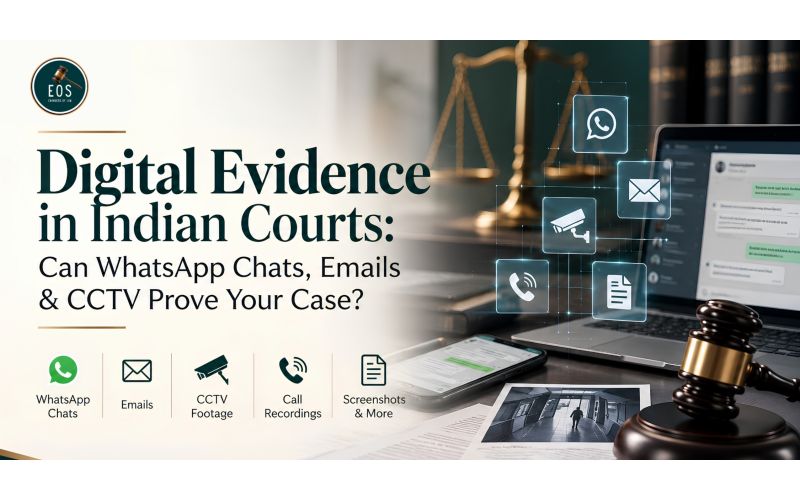
A WhatsApp conversation, an email exchange, a CCTV recording or a voice note can become crucial evidence in a legal dispute. Digital records may help establish communications, reconstruct events, identify participants or corroborate a party’s version of the facts.
However, the existence of a digital record does not automatically make it admissible, authentic or sufficient to prove a case in court.
Indian evidence law recognises electronic and digital records, but their admissibility and evidentiary value depend on the applicable legal requirements, the method of production, the reliability of the record and the circumstances in which it was created or preserved.
The Bharatiya Sakshya Adhiniyam, 2023 (BSA), which came into force on 1 July 2024, provides the current statutory framework for electronic evidence in proceedings governed by the new law. Sections 61, 62 and 63 are particularly important when dealing with electronic records. [1]
This article explains how digital evidence is treated under Indian law, when certificates are required, why metadata and chain of custody matter, and how courts may approach manipulated or AI-generated material.
1. What Is Digital Evidence Under Indian Law?
Digital evidence, also referred to as electronic evidence, includes information created, stored, transmitted or reproduced through electronic devices and computer systems.
Common examples include:
-
WhatsApp and other messaging-app conversations
-
Emails and email attachments
-
CCTV and security-camera footage
-
Audio recordings and call recordings
-
Photographs and videos stored on phones
-
Screenshots of websites, messages or social-media posts
-
Electronic business records and transaction logs
-
GPS and location records
-
Server logs, access records and digital audit trails
-
Computer files, cloud-stored documents and other electronic records
Section 61 of the BSA provides that an electronic or digital record cannot be denied admissibility merely because it is electronic or digital, subject to the statutory framework, including Section 63. Section 62 addresses proof of the contents of electronic records in accordance with Section 63. [2]
This means that electronic records can have legal significance comparable to conventional documentary evidence. It does not mean that every electronic file must automatically be accepted as genuine or that its contents are necessarily true.
Three separate questions should therefore be considered:
-
Admissibility: Can the record legally be received in evidence?
-
Authenticity: Is the record what its producer claims it to be?
-
Evidentiary weight: How strongly does it support the facts in dispute?
A record may satisfy one of these questions without conclusively satisfying the others.
2. Can WhatsApp Chats Be Used as Evidence in Court?
Yes. WhatsApp conversations may be relevant in civil and criminal proceedings, depending on the issues involved and the applicable rules of evidence.
For example, a WhatsApp exchange may be relied upon to establish:
-
A communication between parties
-
A representation, promise or admission
-
Instructions given to an employee or business associate
-
Discussions concerning a transaction
-
Threatening or allegedly defamatory messages
-
Communications relevant to a contractual or commercial dispute
However, the court may need to determine whether the conversation is genuine, who participated in it, whether the messages are complete and whether the surrounding context supports the interpretation being advanced.
Why a screenshot may not be enough
A screenshot is a visual representation of information displayed on a device. By itself, it may not establish the complete conversation, the identity of the person using an account or the absence of alterations.
Relevant questions may include:
-
Can the conversation be traced to the relevant device or account?
-
Are the dates, times and participants consistent with other evidence?
-
Has the complete conversation been preserved?
-
Are relevant messages missing from the sequence?
-
Can the record be independently authenticated?
A screenshot may still be relevant, but its legal treatment depends on the circumstances and applicable requirements for proving electronic records.
Best practice for preserving WhatsApp evidence
Preserve the original phone and the complete relevant conversation wherever possible. Retain available message details, attachments, timestamps and associated records. Avoid relying exclusively on cropped screenshots.
Where a conversation is exported or copied to another medium for court use, obtain legal advice on the certificate and other proof requirements applicable under Section 63 of the BSA.
3. Are Emails Admissible as Evidence?
Emails can be important evidence in commercial disputes, employment matters, contractual disagreements, fraud allegations and other proceedings.
An email may help establish the terms of a transaction, the timing of a communication, the instructions given to a party or the course of dealings between businesses.
Nevertheless, an email printout does not necessarily establish every fact asserted about it.
A court may need to consider:
-
The sender and recipient details
-
The date and time of transmission
-
The complete email chain
-
Relevant attachments
-
Available message headers and routing information
-
Whether the account or communication has been compromised
-
Whether the email is consistent with other evidence
Where authenticity is disputed, the original electronic record, available technical information and evidence from relevant custodians may become important.
Practical point: Preserve the email in its original electronic format where possible, including its headers and attachments. A printed copy may be convenient for review, but it should not replace preservation of the underlying record.
4. Can CCTV Footage Prove a Case?
CCTV footage can be highly relevant where a dispute concerns a physical event, movement of persons, entry or exit from premises, an alleged incident or the sequence of events at a particular location.
It may be used in criminal investigations, civil disputes, workplace inquiries and other proceedings, subject to the applicable law.
However, CCTV footage can raise several evidentiary questions.
Key issues with CCTV evidence
Authenticity: Is the footage from the identified camera and location?
Completeness: Does the recording cover the relevant period, or are there gaps?
Time accuracy: Was the camera’s date and time correctly configured?
Integrity: Has the footage been edited, altered, compressed or otherwise changed in a material way?
Identification: Does the footage actually identify a person or establish the conduct alleged?
Preservation: Was the footage obtained and retained in a reliable manner?
A particularly important practical concern is that surveillance systems may automatically overwrite old recordings. If footage may be relevant to a dispute, a prompt preservation request can prevent potentially important material from being lost.
A recent judicial illustration
In Rajesh Kumar v. State of Haryana and Others, decided by the Punjab and Haryana High Court on 10 July 2026, the Court considered CCTV footage and photographs extracted from it in a criminal matter. The Court emphasised that electronic material does not automatically become legally proved merely because it is produced or marked as an exhibit. It must satisfy the applicable statutory requirements, and its contents must support the inference sought to be drawn. [3]
The case illustrates two distinct requirements: proper proof of the electronic record and a sound evidentiary basis for the conclusion sought to be established.
5. What About Call Recordings and Voice Notes?
Audio recordings, including call recordings and voice notes, may be relevant where the content of a conversation is in dispute.
Examples include alleged threats, admissions, instructions, negotiations or conversations relevant to a transaction.
However, the court may need to examine:
-
Whether the recording is authentic and complete
-
Whether the voices can be identified reliably
-
Whether the recording has been edited or manipulated
-
Whether the recording is audible and intelligible
-
Whether its contents are relevant to the issues
-
Whether the applicable requirements for electronic records have been satisfied
A recording should not be treated as conclusive simply because it contains a voice that appears familiar.
Where a recording is disputed, technical examination or other corroborating evidence may be necessary.
Questions about how a recording was obtained, privacy, confidentiality and any other applicable legal restrictions should also be assessed separately. The admissibility of a recording depends on the facts and applicable law; it should not be assumed that every secretly obtained recording is automatically admissible or automatically inadmissible.
6. Are Screenshots of Social Media, Websites and Messages Enough?
Screenshots are commonly used to preserve online material that may later be deleted, modified or made inaccessible.
They can help document the appearance of a webpage, a social-media post, an online advertisement, a message or other displayed information.
But screenshots have limitations.
A screenshot may not, by itself, establish who created the content, when it was originally published, whether it remained unchanged or whether the displayed account was controlled by the person alleged.
For stronger preservation, consider retaining:
-
The full screenshot, including relevant context
-
The source URL or account details, where available
-
The date and time of capture
-
The original downloaded file, where available
-
Relevant surrounding messages or webpage content
-
Technical information and authentication material where appropriate
Where online content is likely to become important in litigation, obtain advice promptly about preserving the original source and preparing the necessary electronic-record certificate.
A screenshot can be useful evidence, but visual appearance alone does not settle authenticity or legal admissibility.
7. Section 63 of the BSA: Why Is the Electronic-Evidence Certificate Important?
Section 63 of the Bharatiya Sakshya Adhiniyam, 2023 governs the admissibility of specified electronic records produced in electronic form or as computer outputs when its statutory conditions are satisfied.
It is especially important when a party relies on a copy, export, printout, recording or other output generated from an electronic source rather than simply producing the underlying record in its original form.
The statutory framework is comparable in purpose to Section 65B of the former Indian Evidence Act, 1872, but the BSA includes its own certificate format and requirements.
What does the certificate address?
Section 63(4), read with the Schedule to the BSA, provides for a certificate concerning the electronic record. The statutory framework addresses matters including:
-
Identification of the electronic record
-
The manner in which it was produced
-
Relevant device particulars
-
The applicable conditions concerning the computer or communication device
-
The hash value of the electronic record
-
Certification by the appropriate person and an expert in the prescribed format
The Schedule contains Part A and Part B. Part A addresses information and declarations concerning the record and its production; Part B provides for the expert's certification. [4]
What is a hash value?
A hash value is a digital fingerprint generated from data using a mathematical function. It can help identify a particular digital file and check whether its contents have changed between two points of comparison.
If the file changes, its hash value will ordinarily change as well. A matching hash value can support an assessment of integrity, but it does not by itself prove who created the file, whether the original content was truthful or whether the file was genuine before the hash was generated.
Is the certificate just a formality?
No. A certificate should not be treated as an administrative formality that can be ignored until the hearing.
In Arjun Panditrao Khotkar v. Kailash Kushanrao Gorantyal (2020), the Supreme Court explained the importance of compliance with Section 65B of the former Evidence Act when secondary electronic evidence was relied upon. The judgment remains an important authority for understanding the background to electronic-evidence certification, although proceedings governed by the BSA must be assessed under the new statute and its Schedule. [5]
The precise requirements and available procedural options should be assessed in the context of the applicable statute, the type of record and the stage of proceedings.
8. Important 2026 Development: The Supreme Court on Section 63 Certification
In Pune Bar Association v. Union of India, Writ Petition (Civil) No. 599 of 2026, the Supreme Court considered a challenge to Section 63(4) and the Schedule to the BSA.
The petitioner questioned whether requirements involving hash values and expert certification imposed an unreasonable burden on litigants.
By its order dated 22 May 2026, the Supreme Court declined to admit the challenge and upheld the statutory requirements against the challenge before it. The Court explained that hash values and expert certification serve the purpose of protecting the integrity and authenticity of electronic records.
The Court also clarified an important point about the expert's role: the conclusion that Part B can be signed only by an examiner notified under Section 79A of the Information Technology Act, 2000 was not to be treated as binding precedent. The Court left the broader question open, observing that a person with other demonstrable special skill and expertise may potentially qualify where the Court is satisfied on the relevant material. It did not give a final, conclusive ruling on that question. [6]
This development is particularly relevant to lawyers, litigants and organisations that routinely rely on electronic records.
Practical takeaway: Do not assume that an ordinary declaration or a generic certificate will necessarily satisfy the BSA. Use the prescribed format and obtain advice on the appropriate certification for the particular record.
9. Chain of Custody: How Was the Evidence Preserved?
Chain of custody refers to the documented history of the collection, transfer, storage, handling and examination of evidence.
For digital evidence, this history can be important because electronic records may be copied, moved, converted, edited or otherwise altered.
A reliable chain of custody helps address questions such as:
-
Who collected the record?
-
When and where was it collected?
-
From which device, account or system did it originate?
-
Who had access to it afterwards?
-
How was it transferred and stored?
-
Were copies made for examination?
-
Was the integrity of the record checked?
-
Is the record produced in court traceable to the material originally collected?
Recommended preservation practices
Where a digital record may be relevant to litigation:
-
Preserve the original device or source where possible.
-
Avoid editing, cropping or repeatedly converting the original file.
-
Make working copies for review while retaining the original.
-
Record the date, time, source and circumstances of collection.
-
Document each transfer or change in custody.
-
Use appropriate forensic acquisition and hashing procedures where warranted.
-
Obtain the necessary certificate and technical assistance early.
These measures do not automatically establish admissibility, but they can help support the authenticity and integrity of the record.
10. Metadata: The Information Behind the File
Metadata is information associated with a digital file or record. Depending on the format and system, it may include creation or modification times, device details, file properties, location information or other technical data.
Metadata may assist in investigating when a file was created, how it was handled or whether its history is consistent with a party's account.
For example, metadata may be relevant where a party alleges that a document existed on a particular date, a photograph was taken at a particular location or a file was modified after a dispute arose.
However, metadata is not infallible. Some fields can be changed, devices may have incorrect clocks, and copying or converting a file can affect certain properties.
Accordingly, metadata should be assessed alongside the source record, collection method, technical context and other evidence. A timestamp or device label should not automatically be treated as conclusive proof of the event it appears to describe.
11. AI-Generated Evidence and Deepfakes: A Growing Challenge
Artificial intelligence can generate or alter photographs, videos, voices, documents and other digital material.
Such material may appear convincing while being fabricated, manipulated or taken out of context. This creates challenges for courts, investigators, lawyers and parties who rely on electronic evidence.
Examples include:
-
A fabricated audio recording that imitates a person's voice
-
A manipulated video that changes what a person appears to say or do
-
An altered photograph presented as an original
-
An AI-generated document falsely attributed to a business or individual
-
Genuine footage combined with fabricated material
-
Authentic recordings presented with misleading edits or context
How should suspected deepfake evidence be examined?
The appropriate approach depends on the record and the dispute. It may include:
Source verification: Identify the original source, device, account or recording system.
Integrity checks: Examine file properties, hash values and available preservation records.
Technical examination: Where justified, use suitably qualified digital-forensics experts to examine signs of manipulation.
Contextual corroboration: Compare the record with independent footage, contemporaneous communications, witness testimony or other reliable material.
Disclosure of limitations: Technical findings should be evaluated carefully, including the limitations of any detection method.
No single indicator, software output or AI detector should automatically be treated as conclusive proof that a recording is genuine or fabricated.
The Supreme Court's 2026 consideration of Section 63 certification also recognised the growing relevance of authenticity and integrity concerns in an environment where electronic records can be modified and deepfake technology is developing. [6]
The governing principle remains that the party relying on digital material must establish the matters required by the applicable law, and the court must assess the record in its proper evidentiary context.
12. Common Mistakes When Using Digital Evidence
Digital evidence can lose value when it is collected or presented carelessly.
Common mistakes include:
-
Relying only on cropped screenshots
-
Deleting the original conversation or recording
-
Failing to preserve complete message threads
-
Ignoring certificate requirements
-
Editing or converting files without preserving the original
-
Failing to document the source and handling history
-
Assuming that a matching hash value proves the truth of the contents
-
Treating metadata as conclusive without checking its reliability
-
Producing CCTV footage without investigating gaps or timestamp discrepancies
-
Assuming that a recording is genuine simply because a familiar voice appears in it
-
Relying on AI-generated or manipulated material without appropriate verification
These mistakes may create avoidable disputes about admissibility, authenticity and evidentiary weight.
13. A Practical Checklist Before Producing Digital Evidence in Court
Before relying on a WhatsApp conversation, email, CCTV recording or other electronic record, consider the following:
- Identify the specific fact the record is intended to prove.
- Preserve the original device or source where possible.
-
Retain the complete relevant record and surrounding context.
-
Record how, when and from where the material was obtained.
-
Avoid altering the original file.
-
Consider whether a hash value and forensic preservation are appropriate.
-
Identify the person or system capable of authenticating the record.
-
Determine whether a certificate under Section 63 and its Schedule is required.
-
Address any dispute concerning identity, completeness or manipulation.
-
Preserve relevant supporting evidence and maintain a record of custody.
-
Obtain legal advice before filing the material, particularly if its authenticity is disputed.
The exact steps required will depend on the kind of electronic record, the manner in which it is produced and the applicable procedural and evidentiary rules.
14. Does the BSA Apply to Every Case Filed in India?
The BSA came into force on 1 July 2024. However, the repeal-and-savings provisions mean that proceedings pending immediately before commencement may continue under the former Indian Evidence Act, 1872, as specified by Section 170.
Therefore, the applicable evidence law should be identified by examining the nature and procedural status of the particular proceeding rather than relying only on the date when the digital evidence was collected. [1]
This distinction can be important in ongoing civil and criminal matters, particularly where the evidence was created before the new legislation came into force.
Conclusion
Digital evidence has become an important part of litigation in India. WhatsApp chats, emails, CCTV footage, call recordings, screenshots, metadata and electronic business records can all be relevant to proving disputed facts.
However, digital evidence must be properly preserved, authenticated and proved under the applicable law. A screenshot is not automatically conclusive, a recording is not automatically genuine, and a document does not become legally proved merely because it has been submitted to court.
The Bharatiya Sakshya Adhiniyam, 2023 provides a specific framework for electronic records, including the certificate requirements under Section 63. The Supreme Court's 2026 consideration of those requirements reinforces the importance of record integrity, hash values and expert certification, while leaving a specific question about the qualification of experts open.
For litigants and organisations, the safest approach is to preserve electronic material early, document its source and handling, obtain appropriate technical assistance and address the legal requirements before relying on it in proceedings.
In digital litigation, the quality of the evidence depends not only on what a file appears to show, but also on whether its origin, integrity and contents can be established in accordance with law.
Frequently Asked Questions
1. Can WhatsApp chats be used as evidence in Indian courts?
Yes. WhatsApp chats may be relevant evidence, subject to applicable requirements for admissibility, authentication and proof. Screenshots alone may not establish the complete conversation or the identity of the person behind an account.
2. Is a certificate required for electronic evidence under the BSA?
Section 63(4), read with the Schedule to the BSA, prescribes a certificate framework for the electronic records covered by that provision. The precise requirements depend on the record and the manner in which it is produced.
3. Can CCTV footage be rejected for lack of a certificate?
Electronic records produced as copies or computer outputs may face admissibility difficulties if the applicable statutory requirements are not satisfied. The treatment of an original device and the relevant circumstances must be assessed under the governing law.
4. What is the purpose of a hash value?
A hash value acts as a digital fingerprint that can help check whether a file has changed between comparisons. It supports integrity verification but does not, by itself, prove the truth of a file's contents or identify its creator.
5. Can a call recording be used in court without the other person's consent?
There is no safe blanket answer for every situation. Relevance, authenticity, the manner in which the recording was obtained, privacy considerations and applicable legal requirements must be examined in context.
6. Are AI-generated recordings admissible as evidence?
AI-generated or manipulated material is not automatically reliable merely because it exists as a digital file. Its source, authenticity, integrity and evidentiary value require careful assessment, potentially including technical examination.
7. Which law governs electronic evidence in India?
The Bharatiya Sakshya Adhiniyam, 2023 has been in force since 1 July 2024. Proceedings covered by its repeal-and-savings provisions may continue under the former Indian Evidence Act, 1872.
Primary Legal Authorities
-
Bharatiya Sakshya Adhiniyam, 2023, particularly Sections 61–63 and Section 170.
-
Arjun Panditrao Khotkar v. Kailash Kushanrao Gorantyal, Supreme Court of India, 2020.
-
Rajesh Kumar v. State of Haryana and Others, Punjab and Haryana High Court, 10 July 2026.
-
Pune Bar Association v. Union of India, Supreme Court of India, order dated 22 May 2026.
Legal Disclaimer
This article is intended for general informational and educational purposes only and does not constitute legal advice. The admissibility and evidentiary value of electronic records depend on the facts of each matter, the applicable law and the procedural stage of the proceedings. Specific legal advice should be obtained before collecting, disclosing or relying on digital evidence in litigation.