
Who Should Appoint India’s Election Commissioners? The Con
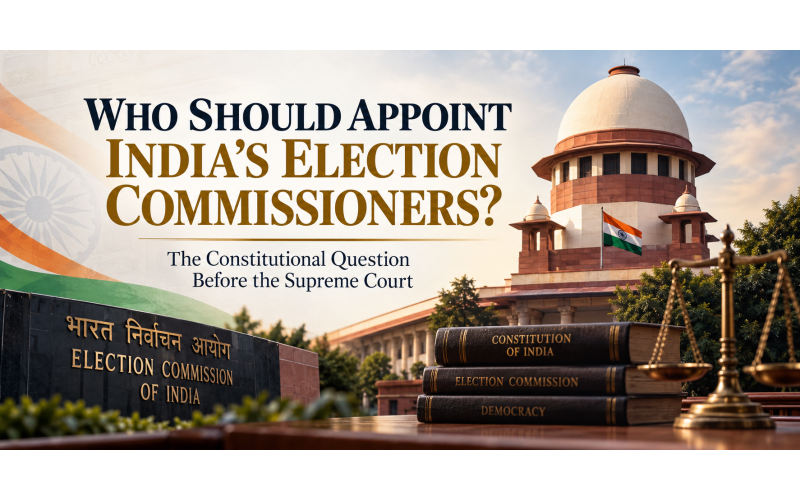
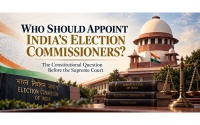
Who Should Appoint India’s Election Commissioners? The Constitutional Debate Before the Supreme Court
|
India’s Election Commission occupies a unique position in the constitutional structure. It is responsible for conducting elections to Parliament, State Legislatures and the offices of the President and Vice-President, making its institutional independence central to the functioning of representative democracy.
Yet one question has generated sustained constitutional debate: who should appoint the people entrusted with administering India’s elections?
The question became particularly significant after the Supreme Court’s landmark judgment in Anoop Baranwal v. Union of India on 2 March 2023. In the absence of a parliamentary law governing the appointment process, a Constitution Bench directed that the Chief Election Commissioner (CEC) and Election Commissioners (ECs) should, until Parliament enacted legislation, be appointed on the recommendation of a committee comprising the Prime Minister, the Leader of Opposition in the Lok Sabha and the Chief Justice of India.
Parliament subsequently enacted the Chief Election Commissioner and Other Election Commissioners (Appointment, Conditions of Service and Term of Office) Act, 2023. The new law replaced the Supreme Court's interim arrangement with a statutory selection mechanism consisting of the Prime Minister, the Leader of Opposition in the Lok Sabha and a Union Cabinet Minister nominated by the Prime Minister.
The legislation was challenged before the Supreme Court. The Court declined to stay the operation of the law in March 2024, while the constitutional challenge continued.
The matter acquired renewed significance in 2026. After extensive hearings, a two-judge Bench delivered differing opinions on 23 September 2026 on whether the challenge to the 2023 framework should be considered by a larger Constitution Bench. The matter was subsequently placed before the Chief Justice for consideration.
On 7 October 2026, the Supreme Court also agreed to examine an application seeking recall of the split verdict. The application raised an apprehension concerning a professional connection involving the son of Justice Satish Chandra Sharma and the Election Commission. Importantly, there has been no judicial finding that Justice Sharma was biased; the Court has only agreed to examine the application and take a decision.
The issue, therefore, is not simply about the identity of the appointing authority. It raises a broader constitutional question:
How should India design an appointment process that protects the Election Commission's independence while respecting Parliament's constitutional authority to legislate?
1. The Constitutional Foundation: Article 324
The starting point is Article 324 of the Constitution of India.
Article 324 vests the superintendence, direction and control of elections in an Election Commission consisting of the Chief Election Commissioner and such number of other Election Commissioners as the President may from time to time fix.
The constitutional framework also provides for the appointment of the CEC and other Election Commissioners by the President.
However, the Constitution did not originally prescribe a detailed statutory procedure specifying:
-
the qualifications of candidates;
-
the mechanism for identifying candidates;
-
the composition of a selection committee;
-
the procedure for shortlisting candidates; or
-
the precise institutional safeguards governing the appointment process.
This constitutional gap became central to the litigation eventually considered by the Supreme Court in Anoop Baranwal.
The important constitutional principle is that Article 324 establishes the Election Commission but leaves significant aspects of the appointment framework to legislation.
That distinction became particularly important when Parliament subsequently enacted the 2023 legislation.
2. How Election Commissioners Were Traditionally Appointed
Historically, appointments to the Election Commission were made through the executive framework.
The Supreme Court in Anoop Baranwal noted that persons appointed as CECs and Election Commissioners had historically largely come from the civil services.
This arrangement was not, by itself, declared unconstitutional.
However, the absence of a detailed statutory selection mechanism generated a constitutional debate concerning whether an institution responsible for conducting elections should have an appointment process that involves a broader range of constitutional actors.
That question ultimately reached a Constitution Bench of the Supreme Court.
3. The Landmark 2023 Judgment: Anoop Baranwal v. Union of India
On 2 March 2023, a five-judge Constitution Bench of the Supreme Court delivered its judgment in Anoop Baranwal v. Union of India. The Bench comprised Justices K.M. Joseph, Ajay Rastogi, Aniruddha Bose, Hrishikesh Roy and C.T. Ravikumar.
The Court was concerned with the constitutional importance of maintaining the independence of the Election Commission.
The judgment recognised that the Election Commission performs a vital constitutional function and that public confidence in the electoral process depends not merely on actual independence but also on institutional safeguards against executive influence.
The interim arrangement
In the absence of legislation governing the appointment process, the Court directed that appointments should be made on the recommendation of a committee comprising:
-
the Prime Minister;
-
the Leader of Opposition in the Lok Sabha, or the leader of the largest opposition party where no recognised Leader of Opposition existed; and
-
the Chief Justice of India.
The Court made clear that this arrangement was intended to operate until Parliament enacted a law governing the subject.
This qualification is important.
The judgment did not permanently rewrite the Constitution or declare that the Chief Justice of India must forever be part of the appointment committee.
Instead, the Court created an interim constitutional arrangement in the legislative vacuum identified by it.
4. Parliament Enacts the 2023 Law
Parliament subsequently enacted the Chief Election Commissioner and Other Election Commissioners (Appointment, Conditions of Service and Term of Office) Act, 2023.
The legislation received presidential assent on 28 December 2023 and became Act No. 49 of 2023.
The Act addresses several aspects of the office, including:
-
appointment;
-
qualifications;
-
search and selection;
-
term of office;
-
salary and conditions of service;
-
resignation;
-
removal;
-
leave;
-
pension and other service-related matters; and
-
protection for actions taken in the discharge of official functions.
The most constitutionally significant provision for the present debate is Section 7, which establishes the Selection Committee.
5. Who Selects the Election Commissioners Under the 2023 Act?
Under Section 7 of the 2023 Act, the Selection Committee consists of:
-
The Prime Minister — Chairperson
-
The Leader of Opposition in the Lok Sabha — Member
-
A Union Cabinet Minister nominated by the Prime Minister — Member
The Act also provides a mechanism for situations where there is no recognised Leader of Opposition in the Lok Sabha, by treating the leader of the single largest opposition party as the Leader of Opposition for this purpose.
This represents a significant departure from the interim arrangement prescribed by the Supreme Court in Anoop Baranwal.
Most notably, the Chief Justice of India is not a member of the statutory Selection Committee.
Instead, the third member is a Union Cabinet Minister nominated by the Prime Minister.
This difference lies at the heart of the constitutional challenge.
6. How Does the Search Process Work?
The 2023 Act does not simply provide for a meeting between the three members of the Selection Committee.
It also creates a Search Committee.
The Search Committee is headed by the Union Minister in charge of the Ministry of Law and Justice and includes two other members who are not below the rank of Secretary to the Government of India.
Its function includes preparing a panel of five persons for consideration by the Selection Committee.
The Selection Committee then considers the candidates in accordance with the statutory procedure.
This distinction between the Search Committee and the Selection Committee is important when analysing the overall appointment framework.
7. Why Is the 2023 Law Being Challenged?
The constitutional challenge broadly raises concerns about whether the statutory structure provides sufficient institutional independence to the Election Commission.
One of the central arguments is that the 2023 Act effectively replaced the Chief Justice of India's position in the Anoop Baranwal arrangement with a Union Cabinet Minister nominated by the Prime Minister.
The petitioners have argued that this may increase the possibility of executive dominance in a body whose constitutional responsibility includes conducting elections involving the very political executive participating in the appointment process.
The challenge therefore involves a fundamental constitutional question:
Does the appointment mechanism provide adequate safeguards for the independence and perceived neutrality of the Election Commission?
The Supreme Court considered these issues when the legislation was challenged in 2024. On 22 March 2024, the Court declined to stay the operation of the law while the challenge proceeded.
8. The Government's Counter-Argument
The constitutional debate cannot properly be understood by considering only the petitioners' arguments.
The Union's position has included the proposition that Parliament has the constitutional authority to legislate on the appointment framework after the Court's interim arrangement in Anoop Baranwal.
During the 2026 proceedings, the Court was reminded that the 2023 judgment itself contemplated parliamentary legislation and that the judicial arrangement was intended to fill the vacuum until Parliament acted.
From this perspective, the principal question is not whether Parliament followed the Supreme Court's interim formula, but whether the legislation enacted by Parliament is itself constitutionally permissible.
The Government has also argued that institutional independence cannot be assessed merely by assuming that executive participation necessarily results in executive control.
This raises an important separation-of-powers issue:
Where should the constitutional boundary lie between judicially imposed safeguards and Parliament's authority to design an institutional framework through legislation?
9. Independence Versus Democratic Accountability
At the heart of the controversy are two competing constitutional considerations.
Argument for greater institutional insulation
Supporters of a more independent appointment mechanism argue that the Election Commission should be protected from possible political influence because it administers elections involving political parties and governments.
From this perspective, involving an institutionally neutral constitutional authority in the appointment process may strengthen public confidence.
The argument is not merely about actual interference.
It is also about the appearance of independence.
During the 2026 proceedings, Justice Dipankar Datta emphasised the importance of the Election Commission not only being independent but also appearing to be independent.
Argument for parliamentary discretion
The opposing position emphasises that the Constitution assigns legislative functions to Parliament.
If Parliament is authorised to establish the statutory framework, courts must exercise caution before replacing Parliament's institutional design with their own preferred model.
This is particularly relevant because Anoop Baranwal itself recognised the temporary nature of the judicial arrangement.
The constitutional question therefore involves a balance between:
institutional independence + public confidence
and
legislative competence + separation of powers.
10. What Happened During the 2026 Supreme Court Hearings?
The constitutional challenge received extensive consideration during 2026.
Hearings took place over several dates, including May, July and thereafter. The petitioners argued that the statutory appointment mechanism undermined the independence of the Election Commission and departed materially from the safeguards recognised in Anoop Baranwal.
The Union, on the other hand, emphasised Parliament's authority to legislate and the fact that the Supreme Court's 2023 arrangement was intended to operate only until legislation was enacted.
The proceedings consequently moved beyond the simple question of whether the CJI should be on the committee.
They raised broader questions concerning:
-
constitutional independence;
-
judicial review of institutional design;
-
separation of powers;
-
parliamentary authority;
-
democratic accountability; and
-
public confidence in constitutional institutions.
11. The Split Verdict of 23 September 2026
On 23 September 2026, Justices Dipankar Datta and Satish Chandra Sharma delivered differing opinions concerning the next procedural and constitutional course of the challenge.
Justice Datta did not consider a reference to a larger Constitution Bench necessary at that stage.
Justice Sharma, however, considered that substantial constitutional questions justified consideration by a larger Bench.
Because the two judges differed, the papers were directed to be placed before the Chief Justice of India for consideration of the desirability of constituting a Constitution Bench to determine the constitutional questions concerning Section 7 and related provisions of the 2023 Act.
This is an important distinction.
The Supreme Court did not, on 23 September 2026, finally declare the 2023 Act unconstitutional.
Nor did it finally determine that the CJI must be part of the appointment committee.
The procedural consequence of the split verdict was that the question of whether a larger Bench should consider the constitutional challenge required further consideration.
12. The 7 October 2026 Development
A further development occurred on 7 October 2026.
The Supreme Court agreed to examine an application seeking recall of the 23 September split verdict. The application raised a concern relating to the professional role of the son of Justice Satish Chandra Sharma, who was reported to be standing counsel for the Election Commission in the Madhya Pradesh High Court.
The issue was raised in the context of an apprehension of possible conflict or bias.
However, it is important to state the legal position accurately:
The Court has not made a finding that Justice Sharma was biased or that his participation was improper.
The Court has agreed to examine the application and take a decision.
Accordingly, it would be premature to describe this development as establishing judicial bias or invalidating the September proceedings.
13. Has the Supreme Court “Reopened” the Constitutional Debate?
Not in the sense of a final determination.
The more accurate description is that the constitutional challenge remains active and that the procedural route forward is currently being considered.
There are now several relevant developments:
-
the 2023 Act remains the statutory framework;
-
the Supreme Court did not stay the law in 2024;
-
the constitutional challenge was heard extensively in 2026;
-
the two-judge Bench delivered differing opinions on 23 September 2026;
-
the possibility of a larger Constitution Bench is under consideration; and
-
on 7 October 2026, the Court agreed to examine an application seeking recall of the split verdict.
Therefore, a headline stating that “the Supreme Court has struck down the appointment law” would be incorrect.
Likewise, stating that the Supreme Court has definitively “reopened” the issue would go beyond the present procedural position.
A more accurate description is:
The constitutional challenge to the 2023 appointment framework remains before the Supreme Court, with further consideration of the appropriate Bench and the recent recall application pending.
14. Why Does the Appointment Process Matter?
The controversy is larger than the question of who sits around the selection table.
The Election Commission exercises constitutional powers that directly affect:
-
general elections;
-
State elections;
-
electoral rolls;
-
election schedules;
-
recognition of political parties;
-
election symbols;
-
election-related directions; and
-
the overall administration of the electoral process.
An appointment mechanism can therefore influence public perception of the institution even where no actual interference occurs.
For a constitutional body exercising powers affecting competing political interests, institutional credibility is itself an important constitutional value.
At the same time, institutional credibility must coexist with the constitutional principle that elected institutions, including Parliament, possess legitimate law-making authority.
The challenge is therefore to design a system that provides both.
15. What Would an Ideal Appointment System Look Like?
The constitutional debate does not necessarily require choosing between “judicial control” and “executive control”.
A robust appointment mechanism could potentially be assessed against several institutional principles.
1. Transparency
The process for identifying and evaluating candidates should be sufficiently transparent to command public confidence.
2. Merit
Candidates should possess appropriate administrative, constitutional and institutional experience.
3. Independence
The process should reduce the possibility of actual or perceived political influence.
4. Accountability
The selection system should remain accountable to constitutionally legitimate institutions.
5. Institutional diversity
No single branch of government should necessarily dominate the entire process.
6. Public confidence
The process should be capable of demonstrating that the Election Commission is independent not merely in theory but also in institutional perception.
These principles can provide a useful framework for evaluating any appointment mechanism, regardless of its precise composition.
16. The Larger Constitutional Question
The dispute ultimately raises a fundamental question about India's constitutional architecture:
How should constitutional institutions be designed when the Constitution leaves important details to Parliament, but those details can affect the independence of the institution itself?
There is no simple answer.
A court may intervene where legislation violates constitutional principles.
Parliament, however, retains an important role in designing statutory institutions within the constitutional framework.
The Supreme Court's eventual consideration of the 2023 Act will therefore have implications beyond the Election Commission.
It could contribute to the broader jurisprudence concerning:
-
independence of constitutional institutions;
-
separation of powers;
-
judicial review of institutional design;
-
limits of parliamentary discretion; and
-
the relationship between constitutional text and constitutional conventions.
17. What Happens Next?
As of 7 October 2026, the constitutional position remains unsettled.
The immediate procedural questions include:
-
Whether the application seeking recall of the September split verdict will succeed.
-
Whether the matter should be placed before a larger Constitution Bench.
-
If a Constitution Bench is constituted, how it will assess the constitutional validity of Section 7 and related provisions of the 2023 Act.
-
Whether the Court ultimately upholds, modifies or invalidates any part of the statutory appointment framework.
Until those questions are decided, the 2023 Act remains the governing statutory framework.
The final constitutional answer may therefore have to wait for further judicial proceedings.
Conclusion
The debate over the appointment of India's Election Commissioners is fundamentally a debate about institutional independence, constitutional accountability and the separation of powers.
The Supreme Court's 2023 decision in Anoop Baranwal addressed the absence of a legislative framework by creating an interim arrangement involving the Prime Minister, the Leader of Opposition and the Chief Justice of India.
Parliament subsequently enacted the 2023 legislation, replacing that interim mechanism with a statutory Selection Committee comprising the Prime Minister, the Leader of Opposition and a Union Cabinet Minister nominated by the Prime Minister.
That legislative choice has become the subject of a continuing constitutional challenge.
The Supreme Court's proceedings in 2026 have brought the issue back into sharp constitutional focus. However, the present position should be described carefully: the Court has not yet finally held the 2023 appointment framework unconstitutional, nor has it finally determined that the Chief Justice of India must be part of the Selection Committee.
The immediate proceedings concern the future course of the constitutional challenge, including whether a larger Constitution Bench should consider the matter and how the recent recall application should be dealt with.
Whatever the eventual outcome, the underlying principle will remain important:
For an institution entrusted with conducting elections, independence must not only exist as a constitutional ideal; the appointment framework must also command confidence that the institution can perform its functions impartially.
Key Legal Takeaways
| Issue | Present Position |
|---|---|
| Constitutional provision | Article 324 establishes the Election Commission |
| 2023 Supreme Court judgment | Anoop Baranwal v. Union of India |
| Interim appointment mechanism | PM + LoP/largest opposition party + CJI |
| 2023 legislation | Chief Election Commissioner and Other Election Commissioners Act, 2023 |
| Current statutory Selection Committee | PM + LoP + Union Cabinet Minister nominated by PM |
| Search Committee | Law Minister + two senior Government officers |
| 2024 Supreme Court position | Court declined to stay the 2023 law |
| 23 September 2026 | Two-judge Bench delivered differing opinions on larger-Bench reference |
| 7 October 2026 | Supreme Court agreed to examine recall application |
| Current status | Constitutional challenge remains pending |
Frequently Asked Questions
Who appoints the Chief Election Commissioner in India?
Under the 2023 Act, the appointment is formally made by the President, on the recommendation of the statutory Selection Committee constituted under Section 7.
Who is on the Selection Committee?
The Selection Committee consists of the Prime Minister, the Leader of Opposition in the Lok Sabha and a Union Cabinet Minister nominated by the Prime Minister.
What did the Supreme Court decide in Anoop Baranwal?
In 2023, the Supreme Court directed that, until Parliament enacted legislation, appointments should be recommended by a committee comprising the Prime Minister, the Leader of Opposition and the Chief Justice of India.
Why was the 2023 Act challenged?
Among other issues, the challenge questions whether replacing the Chief Justice of India with a Union Cabinet Minister nominated by the Prime Minister adequately protects the independence of the Election Commission.
Has the Supreme Court struck down the 2023 Act?
No. As of 7 October 2026, the Supreme Court has not finally struck down the 2023 appointment framework.
Has the Supreme Court finally decided that the CJI must be part of the Selection Committee?
No. The 2023 judgment prescribed the CJI-inclusive mechanism as an interim arrangement until Parliament legislated. The constitutionality of Parliament's subsequent statutory framework remains under challenge.
What happened on 23 September 2026?
The two-judge Bench comprising Justices Dipankar Datta and Satish Chandra Sharma differed on whether the constitutional challenge should be referred to a larger Constitution Bench. The matter was placed before the Chief Justice for consideration.
What happened on 7 October 2026?
The Supreme Court agreed to examine an application seeking recall of the September split verdict. The application raised an apprehension concerning a professional connection involving Justice Sharma's son and the Election Commission. No finding of judicial bias has been made.
Legal Disclaimer
This article is intended for general informational and educational purposes only and does not constitute legal advice. The article reflects the legal and procedural position available as of 7 October 2026. Judicial proceedings concerning the appointment framework of the Election Commission remain subject to further orders and developments. Readers should obtain specific legal advice based on the facts and circumstances of their individual matter.
Primary Legal Sources
-
Constitution of India, Article 324.
-
Anoop Baranwal v. Union of India, Supreme Court of India, judgment dated 2 March 2023.
-
The Chief Election Commissioner and Other Election Commissioners (Appointment, Conditions of Service and Term of Office) Act, 2023.
-
Supreme Court proceedings concerning challenges to the 2023 Act.
-
Dr Jaya Thakur v. Union of India, proceedings culminating in the differing opinions dated 23 September 2026.
Post Categories
Featured Posts




Latest Posts







Latest Posts

Startups and Legal Compliance: A Guide to Navigating Indian Laws
Navigating legal compliance is crucial for startups to establish a strong foundation and ensure sustainable growth. In India, understanding and adhering to applicable laws can be complex but essential. Here’s a concise guide to help startups stay compliant: 1. Incorporation ...
Supreme Court Notice To Airlines, Regulator Over Pee-Gate Victim’s Petition
New Delhi: The Supreme Court Monday agreed to examine the plea of a 72-year-old woman, on whom a male co-passenger allegedly urinated on board an Air India flight in November last year, seeking a direction to the Centre, aviation regulator DGCA ...
Companies Act – Decision To Allot Additional Shares Cannot Be Set Aside Merely Because Promoters Have Also Benefited: Supreme Court
The Supreme Court has upheld the largely disproportionate allotment of rights share in favour of one group of shareholders of a private limited company, substantially increasing its shareholding percentage in the company over other group of shareholders.The bench comprisingJustices K.M. ...

Judicial Decorum vs. Legal Expression: Balancing Dissent with Discipline in India’s Courtrooms
🏛️ The Incident That Sparked a National Conversation The recent events in the Supreme Court of India have reignited a fundamental debate — where does a lawyer’s right to expression end and duty to maintain decorum begin? A courtroom is ...

Can One Poorly Drafted Agreement Lead to Years of Litigation?
Why Smart Businesses Invest in Legal Clarity Before Signing, Not After a Dispute Begins In business, partnerships are built on trust.Transactions are built on opportunity.But when disputes arise, courts do not interpret trust—they interpret documents. One poorly drafted agreement, one ...

Legal Ethics & Professionalism: Building Trust in the Legal Industry
🔹 Integrity. Accountability. Confidentiality. These pillars define a true legal professional. But in today’s fast-paced legal landscape, how do we maintain them? ✔ Upholding Client Confidentiality: A lawyer’s duty is to protect sensitive information—breaching it damages trust.✔ Avoiding Conflicts of ...

Speak With Our
Get a Appointment