
'Hurried Trial' : Supreme Court Sets Aside Death Penalty Giv
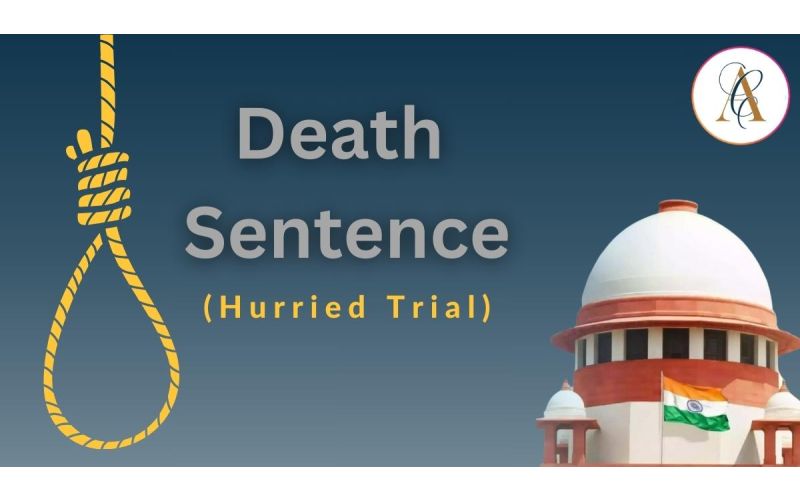
'Hurried Trial' : Supreme Court Sets Aside Death Penalty Given In Child Rape-Murder Case Within 23 Days; Orders Fresh Trial
|
The Supreme Court on Thursday (October 19) set aside the conviction and death sentence of a man accused of kidnapping, raping, and murdering a three-month-old infant after noting that he had not been give a 'proper opportunity' to defend himself. The trial had hit the headlines after being concluded in a record 23 days from the date of the offence.
A bench of Justices BR GavaiPS Narasimha, and Prashant Kumar Mishra was hearing an appeal against a December 2018 judgment of the Madhya Pradesh High Court confirming the conviction and sentence of Naveen, a 25-year-old street-dweller. In March 2019, a bench headed by then-Chief Justice Ranjan Gogoi had granted leave in Naveen's special leave petition and issued a temporary stay on the Indore bench's judgment.
Today, almost a month after reserving the verdict in, the bench led by Justice Gavai pronounced -
"We are of the considered view that the trial court conducted the trial in a hurried manner without giving the accused a proper opportunity to defend himself. Therefore, the judgment of conviction and sentence passed by the trial court and affirmed by the high court is hereby set aside and the matter is remitted to the trial court for de novo trial by according proper opportunity to the appellant to defend himself. . The trial court and the District Legal Services Authority, Indore, are directed to provide assistance of a senior counsel to the appellant to contest the trial on his behalf."
"Something has to be done regarding the criminal jurisprudence of the high courts and the trial courts," Senior Advocate BH Marlapalle, who represented the appellant, remarked after the pronouncement. Both before the Supreme Court and the high court, the appellant's lawyers had argued that the trial had been conducted in a hurry owing to the media glare on the case.
"My learned brother has observed strongly about all this," Justice Gavai revealed. He added, "In another case, when I was sitting with Justice Pardiwala and Justice Sanjay Kumar, we had to do the same thing."
In the judgment, besides noting several gaps in the prosecution case including the strong reliance on circumstantial evidence, the author, Justice Mishra, observed that no 'real' opportunity was accorded to the appellant to defend himself by, among other things, cross-examining the witnesses. He was not allowed a defence lawyer of his own, and was represented by a legal aid counsel. Notably, during the trial, which was conducted on a day-to-day basis, the appellant was given a single day's time to produce expert witnesses. The Supreme Court notes:
"It was impossible for the accused himself to produce the authors of the DNA reports in one day because the experts are government servants and could not have attended the court at the request of an accused in jail. The trial court treated the accused as if he is carrying a magic wand which is available to produce highly qualified experts, who are government servants, on a phone call. There was no opportunity, in the real sense, to the appellant to cross-examine the experts."
The court also stressed the principle of fair trial with reference to a catena of judgments. In the context of fair trial, it also elaborated on the concept of 'judicial calm' and strongly advocated for the observance of the principle, in both letter and spirit -
"In the hallowed halls of justice, the essence of a fair and impartial trial lies in the steadfast embrace of judicial calm. It is incumbent upon a judge to exude an aura of tranquillity, offering a sanctuary of reason and measured deliberation. In the halls of justice, the gavel strikes not in 20 haste, but in a deliberate cadence ensuring every voice, every piece of evidence, is accorded its due weight. The expanse of judicial calm serves not only as a pillar of constitutional integrity, but as the very bedrock upon which trust in a legal system is forged. It is a beacon that illuminates the path towards a verdict untainted by haste or prejudice, thus upholding the sanctity of justice for all."
Background
In May 2018, a man accused of the rape and murder of a three-month-old girl in Madhya Pradesh's Indore was sentenced to death by a sessions court after a 23-day trial. Naveen Gadke was found guilty under the Protection of Children from Sexual Offences Act (POCSO) as well as of various offences under the Indian Penal Code and handed the capital punishment, with the Special Public Prosecutor Akram Sheikh emphasising the severity of the crime and urging the court to treat it as among the 'rarest of the rare' cases. The incident dates back to April of the same year, when an infant was kidnapped near the historic Rajwada Fort in Indore, from where she was sleeping next to her parents on the street. Later, her bloodied body was found in a basement of a nearby building. In the aftermath, several people were questioned and on the same day as the tragic incident, Naveen was arrested. The police concluded its investigation within a period of seven days, and after an expedited trial, the verdict was pronounced on May 12 by the trial court, which was later upheld by the Indore bench of the Madhya Pradesh High Court.
While confirming his death sentence, the bench of Justice PK Jaiswal and Justice SK Awasthi observed: "The rape of a infant is nothing but a monstrous burial of her dignity in the darkness. It is a crime against the holy body of a girl child and the soul of the society and such a crime is aggravated by the manner in which it has been committed. It was not committed by accused under any mental stress or emotional disturbance and it is difficult to comprehend that he would not commit such acts and would be reformed and rehabilitated. The act of the appellant / accused meets the test of 'rarest of the rare case'."
Post Categories
Featured Posts



Latest Posts








Latest Posts

Members Of Railway Protection Force Can Seek Benefit Under Employees Compensation Act Though RPF Declared As An Armed Force: Supreme Court
The Supreme Court on Monday (26.09.2023), held that an officer of the Railway Protection Force (RPF) can seek compensation under Employees Compensation Act, 1923 even though the RPF has been declared to be an armed force of the Union. “..in ...

Parliament Passes Forest (Conservation) Amendment Bill, 2023
After opposition walked out over their demands for discussion on Manipur Violence, the Rajya Sabha passed the contentious Forest (Conservation) Amendment Bill, 2023 today. It aims to amend certain provisions under the Forest (Conservation) Act, 1980, to extend and exempt ...

An In-Depth Look at Environmental and Sustainability Law
In today's rapidly changing world, environmental and sustainability law has become a cornerstone of global legal practices. With increasing awareness of climate change, resource depletion, and environmental degradation, these laws are essential for promoting sustainable development and protecting our planet ...

Inheritance and Succession Laws: What Every NRI Should Know
For Non-Resident Indians (NRIs), navigating inheritance and succession laws in India can be complex. Whether dealing with ancestral property, inheriting assets, or managing family estates, NRIs must understand the legal framework to safeguard their rights and avoid disputes. Here are ...

Freezing of Bank Accounts by ED/GST/Police – Legal Remedies Explained
Has your bank account suddenly been frozen by the Enforcement Directorate, GST authorities, or police investigation? For businesses and individuals alike, a frozen bank account can bring operations to an immediate halt. Why Bank Accounts Are Frozen by Authorities Authorities ...

Anti-Money Laundering (AML) Compliance: Best Practices for Law Firms
In today's globalized economy, money laundering poses a significant threat to financial systems and institutions, including law firms. As facilitators of various financial transactions, law firms are often targeted by money launderers seeking to legitimize illicit funds. Anti-Money Laundering (AML) ...

Speak With Our
Get a Appointment