Constitutional Law deals with the interpretation and application of the Constitution of India. It covers Fundamental Rights, the powers of the Union and State governments, legislative competence under the Seventh Schedule, judicial review, constitutional remedies, and the legal limits of state power.

Defending Fundamental Freedoms & Checking Arbitrary State Power
The Constitution of India is the foundation of the country's legal and governance framework. It guarantees fundamental rights, establishes the powers and responsibilities of public authorities and provides safeguards against arbitrary or unlawful state action. Constitutional law governs the relationship between individuals, institutions and the State, ensuring that governmental powers are exercised within constitutional limits.
At EOS Chambers of Law, we provide legal advisory and representation in Constitutional Law matters, assisting individuals, businesses, organisations and institutions in understanding and protecting their constitutional rights. Our services cover fundamental rights, writ petitions, judicial review, administrative actions, constitutional remedies and disputes involving public authorities.
We approach constitutional matters with a focus on deep legal research, constitutional interpretation, procedural requirements and the practical implications of public law disputes. Whether a matter involves an alleged violation of fundamental rights, an unlawful government decision or a challenge to the exercise of statutory powers, our team works to identify appropriate legal remedies and develop a considered legal strategy.
The Jurisdictional Nuance: Article 32 vs. Article 226
Constitutional Precision: The Supreme Court of India exercises original writ jurisdiction under Article 32 strictly for the enforcement of Part III Fundamental Rights (which is itself a fundamental right). Conversely, High Courts possess broader subject-matter jurisdiction under Article 226, issuing writs for the enforcement of Fundamental Rights as well as 'for any other purpose'—including administrative illegality, ultra vires notifications, and statutory violations. Our constitutional practice navigates territorial jurisdiction, alternate remedy exhaustion, and maintainability without implying guaranteed admission of petitions or predetermined judicial outcomes.
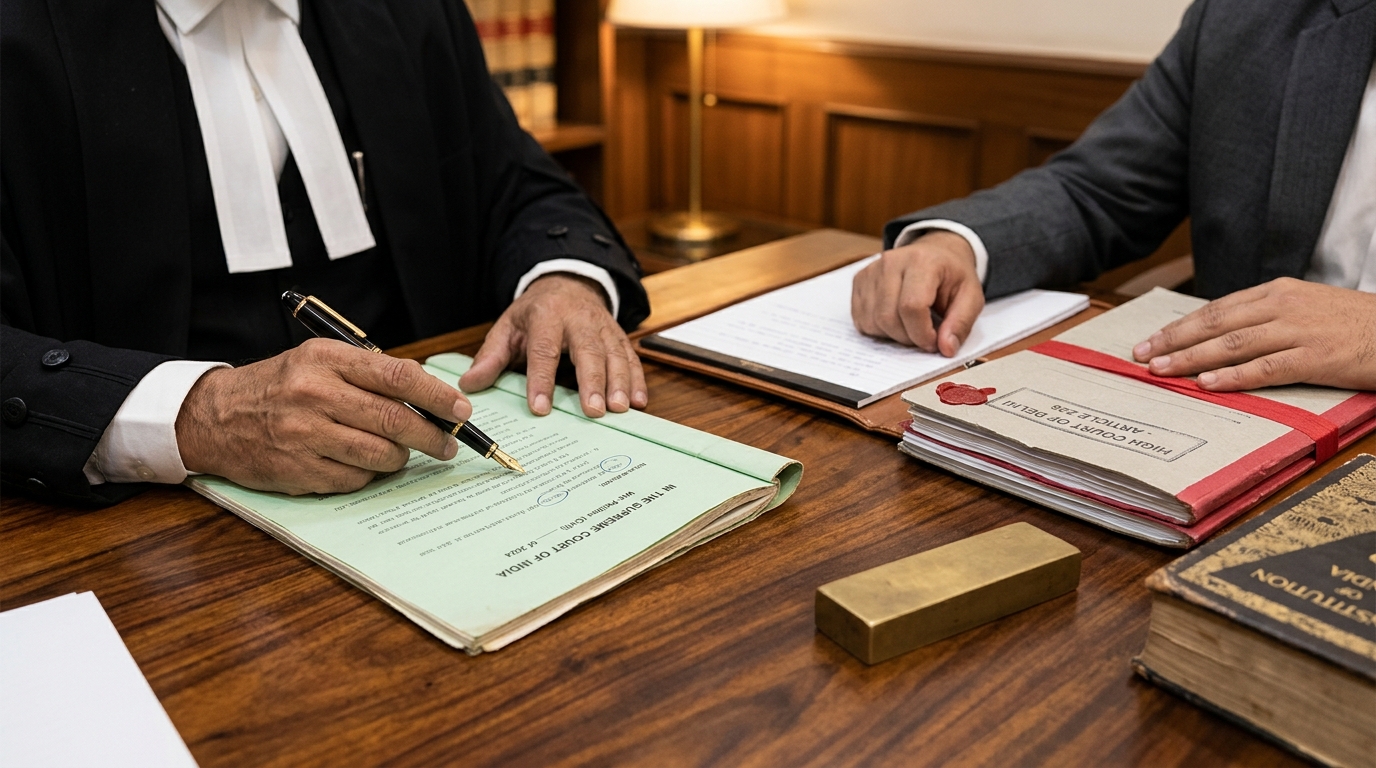
Constitutional Enforcement
Writ Petitions (Articles 32 & 226)
Filing prerogative writs—Habeas Corpus, Mandamus, Certiorari, Prohibition, and Quo Warranto—before High Courts and the Supreme Court to remedy unlawful detention, bureaucratic inaction, or ultra vires orders.
Part III Fundamental Rights • High Courts & Supreme Court
Legislative Scrutiny
Judicial Review & Legislative Vires
Challenging the constitutional validity of parliamentary statutes, state enactments, and subordinate rules for lack of legislative competence under the Seventh Schedule or violation of Article 14 arbitrariness.
Articles 13, 245, 246 • Manifest Arbitrariness Doctrine
Public Accountability
Public Interest Litigation & Institutional Rights
Invoking PIL jurisdiction for systemic governance issues, civil liberty deprivations, environmental accountability, and protecting minority educational rights under Articles 29 and 30.
Articles 21, 29, 30 • Public Law Redressal
Practice Spectrum
Comprehensive Constitutional Law Legal Services
From individual fundamental rights enforcement and criminal due process to federalism challenges and Supreme Court appellate advocacy.
1. Fundamental Rights Protection & Enforcement
Fundamental Rights under Part III of the Constitution protect individuals against arbitrary state action and guarantee equality, liberty, and due process.
- Enforcing Right to Equality & non-discrimination (Articles 14–18)
- Protecting fundamental freedoms of speech, trade & assembly (Article 19)
- Right to Life, Personal Liberty & Privacy under Article 21
- Protection against arbitrary executive discretion & state overreach
- Safeguards against illegal arrest & preventive detention (Article 22)
- Representation in original constitutional writ proceedings
2. Writ Petitions & Constitutional Remedies
Prerogative writs provide rapid, extraordinary remedies against illegal state action, procedural unfairness, or denial of statutory duties.
- Drafting & filing Article 226 writ petitions before High Courts
- Filing Article 32 petitions directly before the Supreme Court of India
- Writ of Mandamus compelling public bodies to perform legal duties
- Writ of Certiorari to quash unsustainable quasi-judicial orders
- Writ of Prohibition restraining ultra vires tribunal proceedings
- Seeking urgent interim stays and status quo injunctions
3. Judicial Review of State & Administrative Actions
Judicial review enables constitutional courts to ensure that public authorities exercise statutory discretion within legal and constitutional bounds.
- Challenges to arbitrary government notifications, circulars & gazettes
- Judicial review of administrative decisions violating natural justice
- Scrutiny of actions exceeding statutory power (Ultra Vires)
- Challenging colorable exercise of power and mala fide decisions
- Wednesbury unreasonableness & proportionality review
- Representation in judicial review proceedings before High Courts
4. Constitutional Challenges to Laws & Regulations
Legislative enactments and delegated rules may be struck down if they violate constitutional guarantees or exceed legislative competence.
- Assessing the constitutional validity of central and state statutes
- Challenging delegated legislation exceeding parent statutory authority
- Challenging discriminatory or manifestly arbitrary legislation under Art. 14
- In-depth constitutional research on legislative intent and doctrine
- Drafting vires challenges to statutory rules and government orders
- Advising on commercial consequences of statutory invalidation
5. Federalism & Centre-State Constitutional Matters
India's federal architecture distributes legislative and executive powers across the Union, State, and Concurrent Lists of the Seventh Schedule.
- Advisory on legislative competence under Articles 245 and 246
- Analysis of Union (List I), State (List II) & Concurrent (List III) subjects
- Doctrine of Pith and Substance, Colorable Legislation & Repugnancy (Art. 254)
- Centre-State fiscal, statutory, and regulatory demarcation disputes
- Advising corporate entities on overlapping central and state regulations
- Representation in original federal suits under Article 131 where applicable
6. Constitutional Rights in Criminal Justice & Liberty
Constitutional protections are vital in criminal law, safeguarding personal liberty against unlawful arrest, detention, and investigative overreach.
- Habeas Corpus petitions for unlawful detention or custody
- Article 20 protections: double jeopardy & protection against self-incrimination
- Article 21 due process, fair trial guarantees & bail jurisprudence
- Challenging arbitrary arrest procedures violating DK Basu guidelines
- Remedies against custodial abuse and non-compliance with Section 41A CrPC/BNSS
- Constitutional bail petitions before High Courts and the Supreme Court
7. Public Interest Litigation (PIL)
Public Interest Litigation allows citizens and organizations to seek judicial remedies for public wrongs, constitutional violations, and executive apathy.
- Evaluating suitability, maintainability & locus standi for PILs
- Drafting PIL petitions strictly adhering to High Court PIL rules
- Matters concerning environmental protection & ecological preservation
- Enforcing fundamental rights of underprivileged & vulnerable classes
- Challenging systemic governance failures & public authority inaction
- Advocacy before High Court Division Benches and the Supreme Court
8. Constitutional Law & Administrative Accountability
Public authorities must exercise their statutory powers transparently, without bias, and in conformity with the principles of natural justice.
- Enforcing constitutional accountability against administrative delay & abuse
- Challenging unreasoned, non-speaking administrative orders
- Remedies against bias (personal, subject-matter, or pecuniary)
- Enforcing Audi Alteram Partem (right to a fair hearing) in public bodies
- Constitutional oversight over statutory regulators and civic corporations
- Restitution and compensation claims for gross constitutional injury
9. Minority Rights & Educational Institutions
The Constitution confers specific protections for linguistic, religious, cultural, and educational freedoms under Articles 25 through 30.
- Advisory on religious freedoms under Articles 25, 26, 27, and 28
- Minority educational rights under Article 30(1) (establishment & administration)
- Challenging government interference in minority institutional autonomy
- Admission, fee-regulation, and affiliation disputes with state universities
- Protection of cultural and educational interests under Article 29
- Representation in constitutional litigation involving educational trusts
10. Constitutional Litigation & Supreme Court Matters
Constitutional disputes frequently involve substantial questions of law requiring authoritative determination by the Supreme Court of India.
- Drafting & arguing Special Leave Petitions (SLP) under Article 136
- Appeals on substantial questions of constitutional interpretation (Art. 132/133)
- Invoking plenary justice powers of the Supreme Court under Article 142
- Intervention applications in ongoing Constitutional Bench references
- Review Petitions (Article 137) and Curative Petitions
- High Court certificate of fitness applications under Article 134A
Constitutional Architecture
Constitutional Remedial Hierarchy in India
Under Indian constitutional jurisprudence, judicial review operates as an integral feature of the basic structure. The constitutional courts possess extraordinary authority to issue directions, declare statutes ultra vires, and compel public accountability.
Grounds for Invalidating Legislative & Executive Action
1. Legislative Incompetence: Act enacted beyond the legislative lists of the Seventh Schedule (Union, State, Concurrent).
2. Violation of Part III Fundamental Rights: Infringing Articles 14 (Equality), 19 (Freedoms), or 21 (Life and Liberty).
3. Manifest Arbitrariness: State action enacted without determining principle, logic, or proportionality.
4. Procedural Impropriety & Natural Justice: Denial of fair notice, bias, or passing non-speaking administrative orders.
5. Basic Structure Violation: Constitutional amendments destroying core pillars like secularism, judicial independence, or democracy.

High Courts (Article 226 & 227)
Plenary writ jurisdiction to issue directions, orders, or writs for enforcing Fundamental Rights and 'for any other purpose', alongside superintendence over all subordinate courts and tribunals.
Article 226 Writs
Article 227 Supervisory
Interim Stays
Supreme Court (Article 32)
The 'protector and guarantor of Fundamental Rights'—direct constitutional petitions without requiring prior approach to subordinate forums where fundamental freedoms are imperiled.
Article 32 Original
Fundamental Rights
Habeas Corpus
Supreme Court Appellate (Article 136)
Extraordinary discretionary jurisdiction to grant special leave to appeal from any judgment, decree, sentence, or order in any cause or matter passed by any court or tribunal in India.
Article 136 SLP
Article 142 Inherent Power
Constitutional Benches
Strategic Methodology
Our 4-Step Approach to Constitutional Law Matters
A disciplined, precedent-driven methodology ensuring meticulous constitutional research, evidentiary precision, and decisive courtroom advocacy.
01
Understanding the Constitutional Issue
Granular examination of the underlying facts, identifying the specific constitutional provisions infringed, assessing state action, and evaluating maintainability.
02
Constitutional & Precedent Research
Exhaustive research into Supreme Court Constitutional Bench precedents, High Court rulings, legislative debates, and foreign comparative jurisprudence.
03
Legal Strategy & Writ Drafting
Drafting articulate, persuasive writ petitions, supporting affidavits, and urgent applications for interim stay, demonstrating manifest arbitrariness or rights violation.
04
Courtroom Advocacy & Follow-Through
Rigorous oral advocacy before Constitutional Benches, securing interim protective orders, argued final disposal, and ensuring compliance with court directions.
The EOS Advantage
Why Clients Entrust EOS Chambers with Constitutional Matters
Constitutional litigation demands academic mastery of public law, procedural rigor, and seasoned courtroom presence before the highest judicial forums.
Constitutional Law Mastery
Deep domain command over Fundamental Rights jurisprudence, administrative law doctrines, federal structure nuances, and constitutional interpretation.
Strategic Legal Research
Meticulous constitutional scholarship analyzing landmark Constitutional Bench precedents to build compelling, logically unassailable arguments.
High Court & Supreme Court Writs Track Record
Proven track record drafting and arguing high-stakes writ petitions, Special Leave Petitions, and PILs before High Courts and the Supreme Court.
Rights-Based Advocacy
Relentless commitment to defending personal liberty, equality before law, due process, and protecting clients against arbitrary executive excess.
Public Authority Accountability
Extensive experience challenging arbitrary government tenders, unreasoned administrative rejections, and regulatory overreach.
Client-Centred, Principled Representation
Strategic public law solutions calibrated to achieve immediate interim protection and long-term constitutional vindication.
Client Engagement
Who Can Benefit from Our Practice
We represent diverse individuals, commercial enterprises, institutions, and civic bodies navigating constitutional and public law issues.
1. Individuals Seeking Fundamental Rights Enforcement
Citizens challenging state violations of equality (Art. 14), personal liberty (Art. 21), or fundamental freedoms before High Courts.
2. Businesses Affected by Arbitrary Government Action
Corporations and commercial enterprises challenging arbitrary regulatory bans, retrospective rules, or unfair tender cancellations.
3. Educational Institutions & Minority Establishments
Schools, universities, and trusts asserting institutional autonomy, admission rights, and protections under Articles 29 & 30.
4. NGOs & Public Interest Advocacy Groups
Civil society organizations initiating Public Interest Litigations for environmental justice, transparency, and civil rights.
5. Professional Associations & Institutional Bodies
Trade bodies and professional associations challenging statutory notifications or legislative provisions impacting their sector.
6. Persons Facing Unlawful Detention or Arrest
Individuals seeking immediate Habeas Corpus relief, constitutional bail, or protection against coercive custodial measures.
7. Organisations Challenging Legislative Vires
Entities challenging the constitutional validity of Acts, subordinate regulations, or state rules beyond legislative competence.
8. Citizens Impacted by Administrative Inaction
Property owners and citizens seeking Writs of Mandamus to compel statutory authorities to discharge legally mandated duties.
9. Public Bodies Requiring Constitutional Advisory
Statutory corporations, municipal councils, and autonomous bodies seeking legal opinions on powers, limits, and service rules.
10. Litigants in Supreme Court Constitutional Appeals
Parties filing or defending Special Leave Petitions (SLP under Art. 136) or statutory appeals on substantial constitutional questions.
Clarity on the Law
Frequently Asked Questions on Constitutional Law & Writs
Key legal guidance regarding fundamental rights, High Court and Supreme Court writs, and challenging government actions in India.
Fundamental Rights are basic constitutional guarantees embodied in Part III (Articles 12 to 35) of the Constitution of India. They include the Right to Equality (Articles 14-18), Right to Freedom (Articles 19-22), Right against Exploitation (Articles 23-24), Right to Freedom of Religion (Articles 25-28), Cultural and Educational Rights (Articles 29-30), and the Right to Constitutional Remedies (Article 32).
Article 32 empowers individuals to approach the Supreme Court directly solely for the enforcement of Part III Fundamental Rights (a fundamental right in itself). Article 226 empowers High Courts to issue writs not only for the enforcement of Fundamental Rights but also 'for any other purpose'—giving High Courts a broader subject-matter jurisdiction to review administrative illegality, ultra vires actions, and statutory violations.
A writ petition is an extraordinary constitutional remedy filed before a High Court (under Article 226) or the Supreme Court (under Article 32) praying for a formal judicial command or prerogative writ against the State, a statutory authority, or a public functionary to enforce legal rights or quash unlawful orders.
The five prerogative writs are:
• Habeas Corpus: To secure immediate release from unlawful detention.
• Mandamus: To compel a public authority to perform a mandatory statutory duty.
• Certiorari: To quash an unconstitutional, illegal, or jurisdiction-exceeding order passed by a public body or quasi-judicial tribunal.
• Prohibition: To prevent a lower tribunal from exceeding its jurisdiction.
• Quo Warranto: To challenge the lawful title of an individual occupying a public office.
Yes. A government decision, executive order, or statutory notification can be challenged on established constitutional grounds: lack of jurisdiction or ultra vires, violation of Fundamental Rights (such as Article 14 arbitrariness or Article 21 due process), procedural unfairness or breach of natural justice, and manifest unreasonableness.
Judicial review is a basic feature of the Indian Constitution empowering the constitutional courts (Supreme Court and High Courts) to examine the validity of legislative enactments, executive orders, and administrative actions to ensure compliance with constitutional mandates and the rule of law.
Public Interest Litigation (PIL) relaxes traditional rules of locus standi, allowing public-spirited individuals or organisations to approach High Courts or the Supreme Court to seek judicial remedies for marginalized communities, environmental degradation, public authority accountability, or systemic constitutional violations.
Yes. The Supreme Court and High Courts possess plenary powers to strike down central or state legislation if it violates Part III Fundamental Rights, exceeds legislative competence under the Seventh Schedule, or breaches other constitutional provisions or the basic structure doctrine.
Generally, writs lie against the 'State' under Article 12. However, constitutional courts have held that private bodies performing essential public duties, discharging statutory functions, or exercising state-delegated sovereign powers may be amenable to writ jurisdiction under Article 226 of the Constitution.
Yes. A person may approach the High Court under Article 226 for violation of Fundamental Rights without exhausting alternate statutory remedies, as the existence of an alternative remedy is a rule of judicial discretion rather than an absolute bar to constitutional writ jurisdiction.
EOS Chambers provides comprehensive constitutional research, drafting of high-stakes writ petitions, interlocutory stay applications, and courtroom advocacy before High Courts and the Supreme Court of India in matters involving civil liberties, regulatory challenges, and government disputes.
Constitutional Counsel
Protecting Your Rights Against Unlawful State Action
Constitutional remedies require prompt action, precise grounds, and seasoned advocacy before High Courts and the Supreme Court. Consult EOS Chambers of Law for strategic, confidential counsel on your public law matter.
+91 8595 655 395
contact@eoschambersoflaw.com
New Delhi: C-58, Nizamuddin East | Delhi High Court Chamber: 326
Request a Constitutional Law Consultation
Share brief details of the state action, order, or rights violation. Strict attorney-client confidentiality assured.