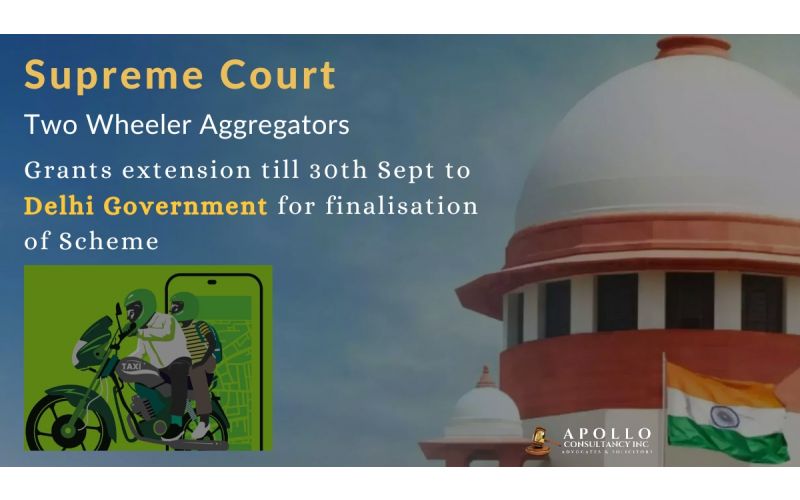
The Supreme Court on Monday directed the Delhi government to finalise the Delhi Motor Vehicle Aggregator and Delivery Service Provider Scheme, 2023 for regulation of two wheeler aggregators by September 30.
The Division Bench of Justice Aniruddha Bose and Justice Bela M. Trivedi granted extension to the Delhi government for finalisation of scheme on request of its Counsel.
However, the Apex Court pointed out that during the previous hearing, the Delhi Government had taken an ‘emphatic stand by,’ submitting that the policy would be notified by July 31.
Earlier on June 12, The Supreme Court on Monday directed bike taxi aggregators such as Rapido and Uber to stop plying bike taxis on the roads of the national capital till the guidelines governing grant of licences to such aggregators was notified
The Vacation Bench of Justice Aniruddha Bose and Justice Rajesh Bindal set aside two orders of the Delhi High Court, which had directed the Delhi government not to take any coercive action against bike taxi aggregators till the government notified guidelines governing the same.
The Apex Court observed that a complete stay on the Delhi government notification that prohibited the operation of bike taxis was unwarranted since the Delhi government was in the process of formulating a policy for granting licences to bike taxi aggregators.
While staying the High Court orders, the top court of the country directed the High Court to hear the challenge to the notification expeditiously.
It further gave liberty to the parties to file early hearing applications before the High Court.
Appearing for the Delhi government, Senior Advocate Manish Vashisht contended that the aggregators were operating two-wheelers without proper licences or permits, as required under Section 93 of the Motor Vehicles Act.
It was argued that non-transport two-wheelers should not be used as taxis without a policy in place.
He further submitted that the Delhi government was working on a policy on licensing regime, which would become operational by July 31, 2023.
Representing Uber, Senior Advocate Neeraj Kishan Kaul submitted that the company had relied on notifications permitting two-wheelers to operate in many states since 2019.
He emphasised that the government’s failure to draft a policy should not lead to a ban on the existing 35,000 bike taxi operators.
The issue of whether two-wheelers fit into the existing taxi aggregator policy was also raised. Uber argued that two-wheelers, except those with engine capacities of 25CC, should be allowed to operate as commercial vehicles based on a notification by the Central government.
Appearing for the Central government, Additional Solicitor General (ASG) Sanjay Jain said that the Centre’s guidelines were issued to facilitate state governments, so that they could formulate a policy for licences to aggregators.
The High Court of Delhi had ordered the Delhi government in May not to take any coercive action against the bike taxi aggregators such as Rapido and Uber, giving them permission to operate till guidelines governing such aggregators were notified.
In February this year, the Delhi government had issued a public notice stating that bike taxis were not allowed in the national capital.
The government pointed out that two-wheelers having non-transport (private) registration indulging in purely commercial operations would be in violation of the Motor Vehicles Act and rules made under the Act.