
S. 50 NDPS Act Not Applicable To Recovery From Bag Carried B
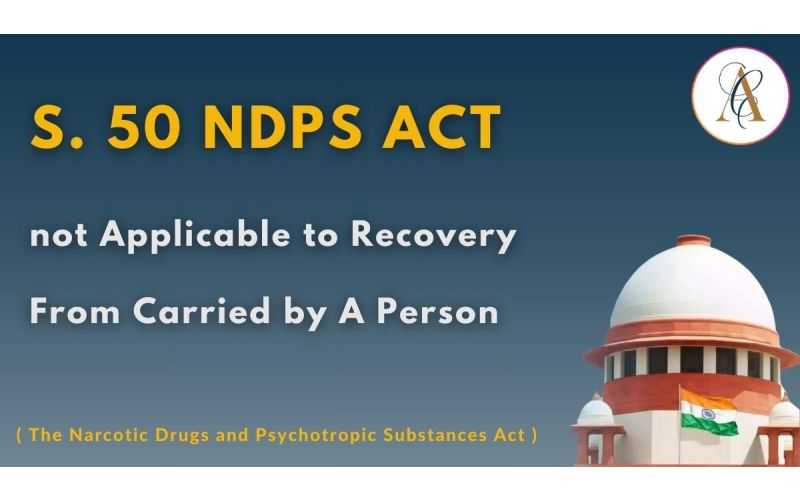
S. 50 NDPS Act Not Applicable To Recovery From Bag Carried By A Person: Supreme Court
|
The Supreme Court recently reiterated that the conditions for personal search as specified in Section 50 of the Narcotic Drugs and Psychotropic Substances Act are applicable only for the search of the physical body of the person and not for the search of any bag carried by the person.
At the same time, the Court acknowledged that confining the applicability of Section 50 NDPS Act only to the physical body and excluding a bag carried by a person can defeat the purpose of the provision, which is to provide a safeguard against abuse of powers by the investigating agency during a search operation.
However, the Court said that it has to go by the plain language of the provision. A two-judge bench comprising Justices MM Sundresh and JB Pardiwala observed :
"It could legitimately be argued that the interpretation of Section 50 restricting its scope only to the search of a person of the accused would frustrate the object as the apprehension of the person concerned may continue to subsist that he may still be implicated by the police or any other person for more stringent punishment of carrying commercial quantity by getting rid of the rigor of the mandatory provision of Section 50 by implanting the contraband in a vehicle, bag, etc. accompanying the person."
Nevertheless, the bench added that it was bound by larger bench decisions which interpreted the plain language of the section to hold that Section 50 was applicable only to the person.
The judgment, made extensive reference to various precedents which laid down different interpretations of Section 50. One strand of decisions took a strict view to hold that the provision is applicable only to the search of the person. However, over a period of time, this Court started reading the word “person” in a slightly broader sense so as to mandate that Section 50 be complied with even while conducting a search of anything that is inextricably linked to the accused. As a result, a bag which was being carried by the accused was considered to be inextricably linked to the accused, and therefore, any recovery of a contraband from such a bag.
In view of the cleavage of opinions, the matter was referred to a larger bench, which in State of H.P. v. Pawan Kumar reported in (2005) 4 SCC, which held that the term “person” under Section 50 would mean a natural person or a living unit and not an artificial person i.e., a bag or a briefcase.
Pawan Kumar also stated the Constitution Bench judgment in State of Punjab v. Baldev Singh, (1999) 6 SCC 172 showed that "the provisions of Section 50 will come intoplay only in the case of personal search of the accused and not of some baggage like a bag, article or container, etc. which he may be carrying."
Thus, in Pawan Kumar the larger Bench while answering the reference in no uncertain terms stated that “a bag, briefcase or any such article or container, etc. can, under no circumstances, be treated as body of a human being. They are given a separate name and are identifiable as such. They cannot even remotely be treated to be part of the body of a human being.”
However, in in Dilip v. State of M.P. reported in (2007) 1 SCC 450, a contrary view was taken to that of Pawan Kumar, by acquitting accused citing non-compliance of Section 50 for seizure from a scooter. Dilip was followed in certain subsequent cases too (eg : SK. Raju alias Abdul Haque alias Jagga v. State of West Bengal reported in (2018) 9 SCC 708).
However, in State of Punjab v. Baljinder Singh(2019), a 3-judge bench held that non-compliance of Section 50 will not invalidate recovery from a vehicle. Baljinder Singh also held Dilip to be not a good law. Baljinder Singh was followed in the 2021 decision Kallu Khan v. State of RajasthanSimilarly, in a 2022 judgement, the Supreme Court in Dayalu Kashyap v. State of Chhattisgarh , held that an extended view of Section 50 cannot be given to include a polythene bag containing narcotics being carried by the accused.
Rhe 2-judge bench, in the instant case, observed that a view could be taken that an object a person carrying could be regarded as part of the body. However, the bench added that the plain language of Section 50 leaves no scope for any interpretation other than the view propounded in
"However, in view of plain and unambiguous statutory provision, there is no scope of interpreting Section 50 in any other manner than the interpretation explained in Baldev Singh (supra) and Pawan Kumar (supra)." stated the judgment.
In the present case, the Court was dealing with an appeal against a judgment of the Himachal Pradesh High Court, which held that Section 50 NDPS Act was not applicable to the recovery from a bag.
"...the High Court was also correct in saying that Section 50 of the NDPS Act was not required to be complied with as the recovery was from the bag." the Court held dismissing the appeal.
Post Categories
Featured Posts





Latest Posts








Latest Posts

Anti-Money Laundering (AML) Compliance: Best Practices for Law Firms
In today's globalized economy, money laundering poses a significant threat to financial systems and institutions, including law firms. As facilitators of various financial transactions, law firms are often targeted by money launderers seeking to legitimize illicit funds. Anti-Money Laundering (AML) ...
Adultery No Longer A Criminal Offence In India, Rules Supreme Court
The Rajya Sabha has passed the Jammu and Kashmir The court underlined that Section 497 treats women as properties of their husbands and is hence manifestly discriminatory. It trashed the central government’s defense of Section 497 that it protects sanctity ...

Legal Confidentiality in the Age of AI - Can Lawyers Safely Use AI Tools?
A Legal and Ethical Guide for Advocates in India Artificial Intelligence is rapidly becoming part of professional legal practice. Lawyers are using AI tools for legal research, drafting, summarisation, document review, proofreading, translation, case-law analysis, contract review and administrative work. ...
Companies Act – Decision To Allot Additional Shares Cannot Be Set Aside Merely Because Promoters Have Also Benefited: Supreme Court
The Supreme Court has upheld the largely disproportionate allotment of rights share in favour of one group of shareholders of a private limited company, substantially increasing its shareholding percentage in the company over other group of shareholders.The bench comprisingJustices K.M. ...

DBS Bank Directors Can’t Be Prosecuted For Acts Of Lakshmi Vilas Bank Before Amalgamation : Supreme Court Quashes Criminal Case
The Supreme Court today ruled that DBS Bank and its directors, who were appointed after the amalgamation with Lakshmi Vilas Bank(LVB) and had their appointments approved by the Reserve Bank of India (RBI), cannot be held criminally liable for actions ...

Navigating the Future: The Rising Demand for Faster Resolutions through Arbitration
Dear community In the ever-evolving landscape of dispute resolution, the demand for faster and more efficient solutions is on the rise. As businesses and individuals seek alternatives to protracted litigation, arbitration has emerged as a compelling choice. Let's delve into ...

Speak With Our
Get a Appointment