
"Why Are You Being So Patriarchal?" : Supreme Court Asks Cen
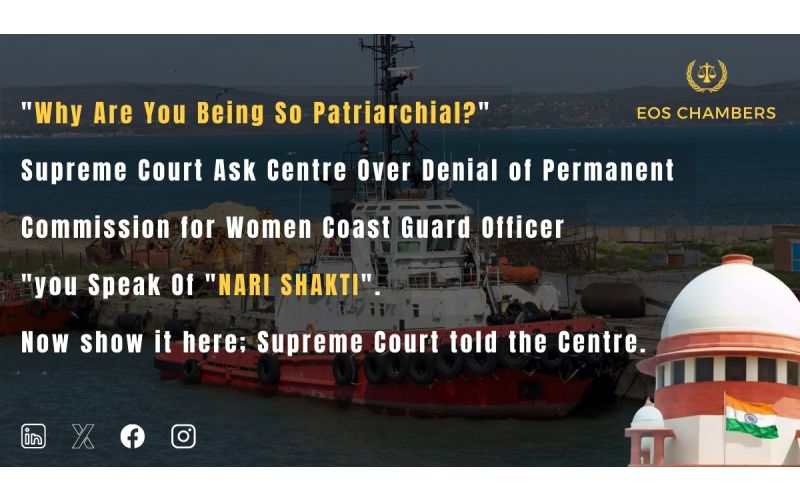
"Why Are You Being So Patriarchal?" : Supreme Court Asks Centre Over Denial Of Permanent Commission To Woman Coast Guard Officer
|
The Supreme Court on Monday (February 19) pulled up the Central Government over the denial of Permanent Commission for women officers in the Indian Coast Guard (ICG).
The bench led by Chief Justice of India DY Chandrachud, hearing a plea of a woman officer in the Short Service Commission, asked if the Union was taking "a patriarchal approach" despite the extensive rulings by the Apex Court on the issue of granting Permanent Commission to women officers in defence services.
Addressing the Union Government, CJI said, "You speak of 'Nari shakti'. Now show it here. You're in the deep end of the sea, in this matter…you must come up with a policy which treats women fairly…after 2009 no woman has been inducted …Why are you being so patriarchal? You don't want to see the face of women in the Coast Guard?”
Pointing out hat permanent commission is now being granted by all three branches of the defence force- army, navy and air force, the CJI said, “She is the only member of her batch who is opting for permanent commission, there are 4 women in her batch and she is the only one who wants permanent commission….clearly now the Coast Guard must come up with a policy”
Additional Solicitor General (ASG) Mr Vikramjit Banerjee, representing the Union, explained that there was a difference between the stream of the Petitioner who was in the Short Service Commission (SSC) and the branch of Permanent Commission (PC) which the petitioner sought to be absorbed into. The issue was the transition sought from SSC to PC.
The CJI was however quick to point out that the ASG should read the Supreme Court's decisions in Ministry of Defence v. Babita PuniyaUnion of India v. Lt Cdr Annie Nagaraja and Union of India v. Lt Cdr Annie Nagaraja which allowed a Permanent Commission for women officers in the Indian Army and Navy respectively.
The CJI asked whether there was a provision for a Permanent Commission of Women in ICG, and the ASG answered in the affirmative and stated “Only for 10%”
The CJI, seeming to be unsatisfied with such a ratio asked, “ Why 10%? women are lesser human beings? …tell us one thing,do only 10% of the male Coast Guards become permanent?”
The bench asked what was so distinctive about the ICG that women could not have Permanent Commission there, while the Indian Navy grants the same.
The Court cautioned the Union to come up with a gender-neutral policy sooner.
“ Forget about her case, we will now deal with what you do to others. We are the Supreme Court, we may not give her liberty but we will see that Justice is done for women in ICG …then we will open up the whole canvas, you better take instructions with what you want to do…if women can guard the borders, they can guard the Coasts, it's as simple as that.”
Senior Advocate Archana Pathak Dave and Siddhant Sharma Advocate-on-Record represented the petitioner.
Background
The Supreme Court on February 12 issued notice on the plea of a woman Short Service Appointment (SSA) Officer, engaged with the Indian Coast Guard (ICG), over denial of consideration for Permanent Commission despite 14 years of service. The Bench, comprising CJI DY Chandrachud, Justices JB Pardiwala and Manoj Misra, was hearing the challenge to a Delhi High Court order dated December 21, 2023, whereby the woman Officer's prayer for interim relief of continuation in service as Commandant (JG), ICG was rejected noting that final relief could not be granted by way of an interim order.
Yhe woman Officer/petitioner was appointed as Assistant Commandant (General Duty-Women) in 2009. She was promoted to the post of Deputy Commandant (GD) in 2015 and to the post of Commandant (JG) in 2021. In 2021, she submitted a request for permanent absorption along with recommendations from her commanding officers.
However, a year later, the request was returned without action, on the basis that the Ministry of Defence's (MoD) letter dated February 25, 2019 (regarding the grant of permanent absorption to women officers) did not apply to ICG. Reportedly, the petitioner also communicated that no provision for permanent absorption/commission of SSA Officers existed in ICG. Rather, the procedure for induction of women officers in the permanent cadre of the GD branch existed and the PMT/SSC option had to be exercised at the time of enrolment.
In May 2023, the petitioner communicated a release order pursuant to the completion of her engagement period. Against the same, she approached the Delhi High Court.
The High Court denied interim relief to the petitioner, being of the view that if the petitioner was ultimately successful, she could be directed to be reinstated retrospectively. However, if she was not successful, any period spent in continuation of service, in terms of an interim order passed, would amount to illegal usurpation of office without any entitlement thereto.
Consequently, the petitioner was released from service in December 2023. Challenging the High Court order, she approached the Supreme Court.
Post Categories
Featured Posts


Latest Posts








Latest Posts
Judge Aspirants Get Relief; Supreme Court Sets Aside BPSC's Rejection Of Candidates For Not Producing Original Certificates
The Supreme Court on Friday (September 22) granted relief to three judicial service aspirants from Bihar whose candidatures were rejected by the Bihar Public Service Commission(BPSC) due to non-production of original certificates at the time of interview. Holding that production ...
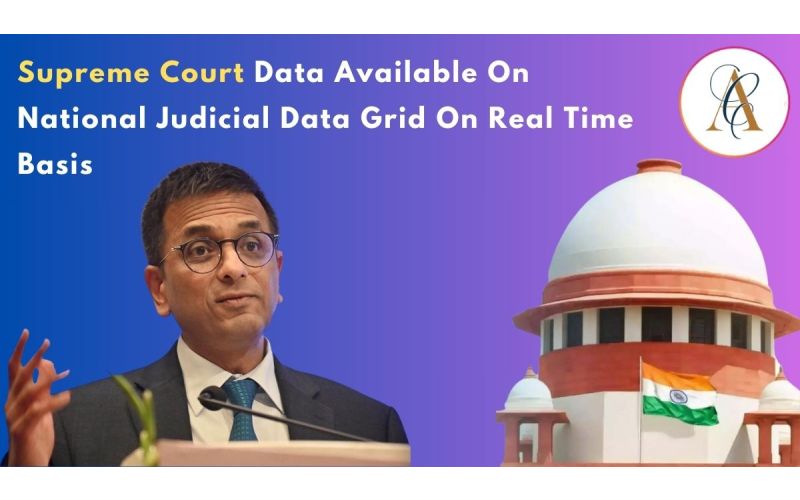
In A First, Supreme Court Data Available On National Judicial Data Grid On Real Time Basis; Boost For Transparency, Says CJI DY Chandrachud
Chief Justice of India DY Chandrachud announced today that the Supreme Court is officially 'onboard' with the National Judicial Data Grid (NJDG) now. The CJI described the onboarding of the Supreme Court data on NJDG portal under the court's 'open ...

Supreme Court Seeks Union's Stand Regarding Cryptocurrency
The Centre has told the Supreme Court it is yet to take a decision on a mechanism to regulate cryptocurrencies and effectively investigate related offences. A bench of justices Surya Kant and KV Viswanathan was told by Additional Solicitor General ...
Supreme Court Dismisses PIL Seeking Independent Audit Of EVM Source Codes
The Supreme Court on Friday refused to entertain a Public Interest Litigation (PIL) seeking an independent audit of source codes of Electronic Voting Machines (EVMs). The bench comprising CJI DY Chandrachud, Justice JB Pardiwala, and Justice Manoj Misra noted that ...
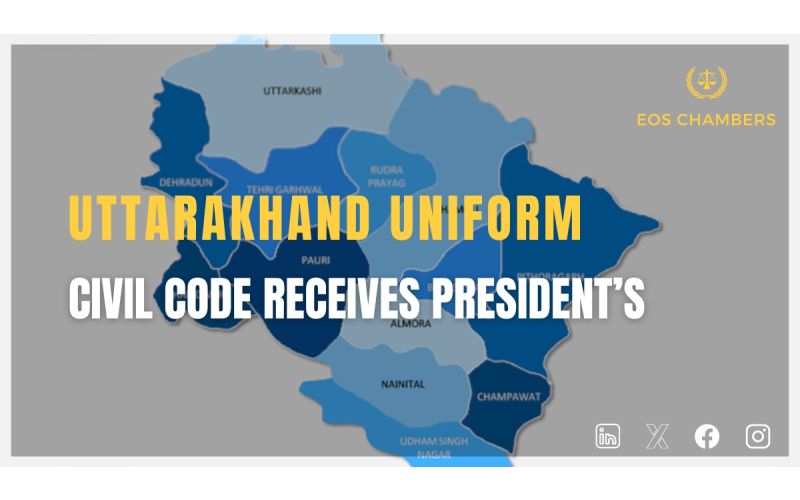
Uttarakhand Uniform Civil Code Receives President's Approval
In a crucial development, the Uttarakhand Uniform Civil Code (UCC) Bill, 2024 has been granted assent by President of India Droupadi Murmu. It may be recalled that in 2022, a committee was formed by Pushkar Singh Dhami-led Uttarakhand Government to ...
Cheque Bounce Case Can Be Quashed U/S 482 Only If Amount Is Patently Non-Recoverable; Whether Debt Time-Barred Or Not Is A Question Of Evidence : SC
The Supreme Court observed that the question whether a cheque was issued towards a time barred debt is to be decided on evidence. “It is only in cases wherein an amount which is out and out non-recoverable, towards which a ...

Speak With Our
Get a Appointment