Why Smart Businesses Invest in Legal Clarity Before Signing, Not After a Dispute Begins
In business, partnerships are built on trust.Transactions are built on opportunity.But when disputes arise, courts do not interpret trust—they interpret documents.
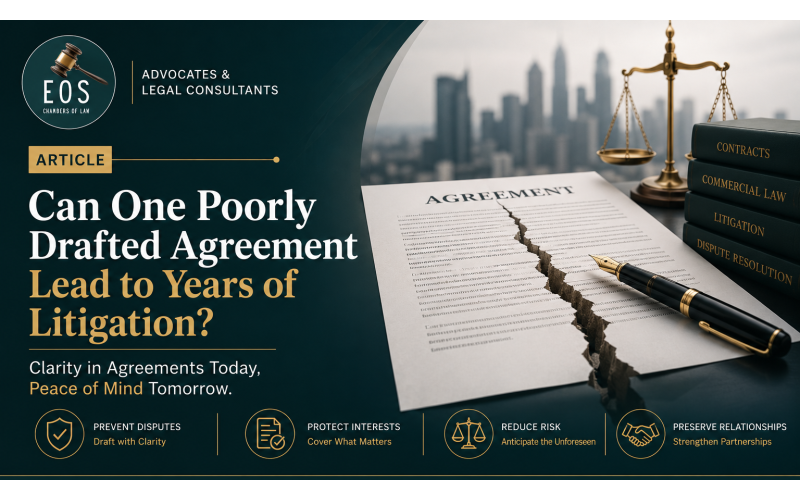
One poorly drafted agreement, one ambiguous clause, or one overlooked legal risk can transform a promising business relationship into years of costly litigation.
At EOS Chambers of Law, we have seen businesses invest crores in expansion, acquisitions, collaborations, distribution networks, licensing arrangements, employment structures, and strategic partnerships—only to discover that the real weakness was never the business model.
It was the agreement.
The uncomfortable truth is:
Most commercial disputes do not begin in courtrooms. They begin at the drafting table.
Why Agreements Matter More Than Ever
In today’s business environment, transactions move faster than ever.
Deals are often finalized over:
- Emails
- WhatsApp conversations
- Video meetings
- Shared templates
- Downloaded contracts
- Informal understandings
But when a dispute arises, informal intentions carry limited value.
What matters is:
- What was documented
- What was agreed
- What was omitted
- What was left open to interpretation
And in litigation, even one unclear sentence can become the foundation of a prolonged legal battle.
Common Agreement Mistakes That Trigger Litigation
1. Ambiguous Commercial Terms
Many agreements fail to clearly define:
- Scope of services
- Deliverables
- Timelines
- Payment milestones
- Performance obligations
When obligations are unclear, expectations differ.
When expectations differ, disputes begin.
Practical Risk:
A vendor believes work is complete. A client believes obligations remain pending.
The agreement says neither clearly.
The result?
Notices. Breach claims. Litigation.
2. Weak Payment & Recovery Clauses
One of the most common causes of commercial disputes in India involves payment defaults.
Yet many agreements fail to address:
- Due dates
- Late payment consequences
- Interest liability
- Recovery mechanisms
- Suspension rights
Without these protections, businesses often face lengthy recovery proceedings.
Practical Risk:
You deliver. The client delays. The agreement offers no enforcement mechanism.
Now recovery becomes a dispute—not a process.
3. No Dispute Resolution Framework
Many businesses sign contracts without defining:
- Jurisdiction
- Governing law
- Arbitration clauses
- Mediation mechanisms
- Notice procedures
When conflict arises, the first dispute becomes:
“Where should this dispute even be heard?”
This alone can add months—or years—to resolution.
4. Inadequate Termination Protection
Business relationships evolve.
But many agreements fail to address:
- Exit rights
- Termination events
- Notice periods
- Post-termination obligations
- Confidentiality after exit
Without clear exit provisions, ending a relationship often becomes more expensive than starting one.
5. Intellectual Property Ownership Is Left Unclear
This is increasingly common in:
- Technology projects
- Marketing retainers
- Software development
- Design contracts
- Consultancy arrangements
Critical questions often remain unanswered:
Who owns the work product? Who owns the code? Who owns the brand assets? Who controls derivative rights?
When success comes, ownership disputes follow.
6. Boilerplate Agreements for Complex Transactions
Perhaps the most expensive mistake businesses make:
Copy-pasting agreements from the internet.
What works for one jurisdiction, one industry, or one business model may create serious legal exposure for another.
No two businesses carry identical risks.
Yet many agreements are treated as administrative paperwork rather than strategic legal instruments.
The Real Cost of Poor Drafting
A weak agreement can lead to:
- Commercial litigation
- Arbitration proceedings
- Injunctions
- Payment recovery disputes
- Regulatory exposure
- Loss of intellectual property
- Reputational damage
- Broken investor confidence
- Delayed expansion
- Operational disruption
And often…
Legal costs exceed the cost of proper drafting many times over.
What Smart Businesses Do Differently
Forward-thinking businesses treat agreements as:
- Risk management tools
- Strategic protection instruments
- Business continuity frameworks
- Investment safeguards
They ensure:
- Commercial clarity
- Legal enforceability
- Industry-specific protection
- Exit planning
- Dispute preparedness
Because prevention costs far less than litigation.
EOS Chambers Perspective
At EOS Chambers of Law, we believe an agreement should do more than record a transaction.
It should:
- Protect your commercial interests
- Anticipate potential disputes
- Define accountability
- Strengthen enforceability
- Preserve business relationships
Whether it involves:
- Corporate transactions
- Joint ventures
- Shareholder arrangements
- Vendor contracts
- Employment agreements
- Licensing arrangements
- Cross-border collaborations
Our focus remains the same:
To prevent disputes before they become litigation.
Final Thought
Before signing your next agreement, ask yourself:
Are you signing a business opportunity… or an avoidable future dispute?
Because in business—
A strong agreement doesn’t just protect transactions. It protects relationships, reputation, and long-term growth.
The most expensive litigation often begins with the cheapest contract.
#ContractLaw #CorporateLaw #Litigation #DisputeResolution #BusinessLaw #RiskManagement #LegalStrategy #PreventiveLaw #EOSChambers #CommercialLaw #Contracts #LegalAdvisory #CorporateGovernance #India #BusinessProtection