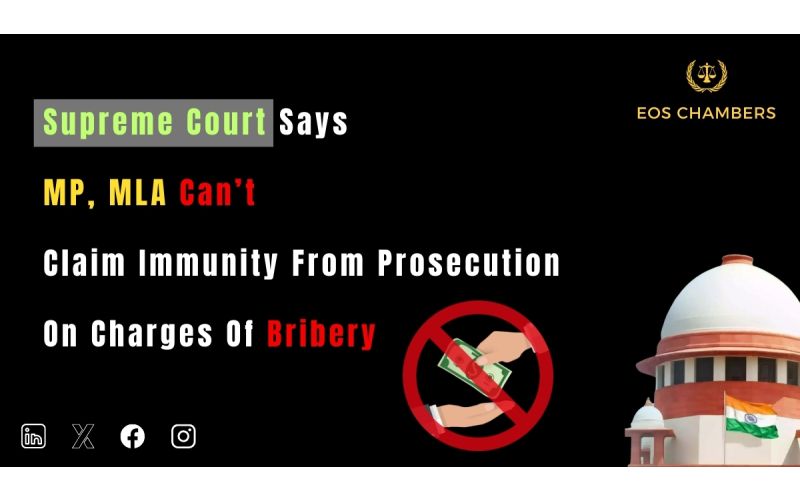
The seven-judge Constitution bench of the Supreme Court said it disagreed with the judgment in PV Narasimha and the judgment in PV Narasimha which grants immunity to legislators for allegedly bribery for casting a vote or speech has “wide ramifications and overruled”.
The Supreme Court’s seven-judge bench in its unanimous view overruled the 1998 PV Narasimha Roa judgment case which granted immunity to MPs/MLAs from prosecution to bribery for voting in Parliament.
While hearing the matter, the Chief Justice said, “We have independently adjudicated on all aspects of the controversy. Do Parliamentarians enjoy immunity? We disagree and overrule majority on this aspect.”
A bench of seven judges headed by the Chief Justice of India in October last year reserved the order after hearing the submissions. Other judges on the bench are Justices AS Bopanna, MM Sundresh, PS Narasimha, JB Pardiwala, Sanjay Kumar, and Manoj Misra.
Earlier, a five-judge bench referred the matter to a larger bench of seven judges to deal with the issues, observing that it was an important issue having a significant bearing on the morality of polity.
The court said that the purpose of Article 105(2) and Article 194(2) is to ensure that members of parliament and state legislatures are able to discharge duties in an atmosphere of freedom without fear of the consequences.
On March 7, 2019, a three-judge bench of the Supreme Court referred the matter to a larger bench, considering the wide ramifications of the question that has arisen. The court had then observed that the doubts raised and the issue being a matter of substantial public importance, the matter required to be considered by a larger bench.
The issue was raised while the court was hearing a petition filed by politician Sita Soren. Sita Soren has sought the criminal prosecution launched against her to be nullified on a claim of immunity under Article 194(2) of the Constitution of India.
The charges against Sita Soren were that she had allegedly accepted a bribe to vote in favour of a particular candidate in the Rajya Sabha election that was held sometime in 2012 in Jharkhand.