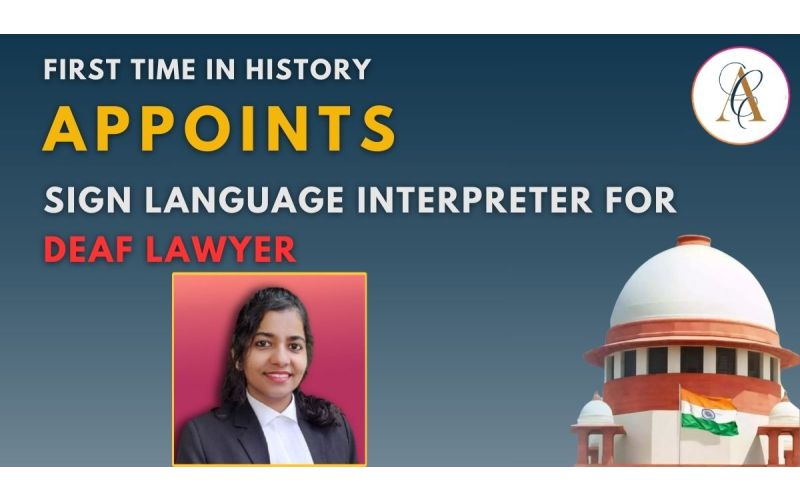
The Supreme Court in India has started allowing sign language interpretation for hearing impaired lawyers, demonstrating that not everything needs to be spoken aloud in court. In a recent case, a deaf advocate was permitted to virtually argue with the help of a sign language interpreter.
NEW DELHI: The Supreme Court has begun allowing case proceedings to be translated through sign language for hearing impaired lawyers, sending a message that everything need not be spoken aloud in courts.
On Friday, advocate-on-record Sanchita Ain made an unusual request to a CJI DY Chandrachud-led bench — deaf advocate Sarah Sunny be permitted to virtually argue a case concerning rights of Persons with Disability (PwD) with the help of sign languageinterpreter Saurav Roychowdhury. The CJI immediately agreed and the virtual court supervisor opened online hearing windows for Sarah and Saurav.
The loud world of courts got translated silently through sign language for the high-spirited hearing impaired advocate. Her case was listed at serial no. 37, but the bench permitted the duo to remain logged in for the day’s proceedings.
Next few minutes were an eye-opening experience for many who watched the duo’s deliberations. At first, it was the interpreter who through rapid hand and finger movements conveyed to Sarah the proceedings before the court and who said what. As the CJI-led bench made a rapid fire round of listing of cases mentioned for urgent listing, solicitor general Tushar Mehta said, “The speed with which the interpreter conveyed the court proceedings to the lawyer was amazing!” the CJI agreed.
When the case, a petition filed by Javed Abidi Foundation, was called out, the Sarah-Saurav duo did a rapid tango of silent sign language-converted-to-arguments. When the CJI-led bench turned to the Centre for an answer, additional solicitor general Aishwarya Bhati said, “An updated status report shall be filed by the Union government so that the petition can be finally disposed of on the next occasion.”
On Monday, founder president of Bhumika Trust Jayant Singh Raghav, who is blind, argued for implementation of the proviso to Section 24 of the Rights of PwD Act, which said “assistance to the persons with disabilities under such (welfare) schemes and programmes shall be at 25% higher than the similar schemes applicable to others.” The has sought response from the Union government. For visually impaired lawyers, advocate Santosh Kumar Rungta remains the living example of “where there is a will there’s a way”. He has not allowed blindness to impede his case presentation skills and was deservedly designated ‘senior advocate’ by the Delhi high court in 2011 — he’s the first visually impaired person to get the coveted senior lawyer gown.
Last year, the CJI had enlisted his services to audit the accessibility of persons with disability to the SC website. Rungta was instrumental in getting a direction from the SC in 2013 for implementation of 3% reservation for differently-abled persons in government jobs. Justice Chandrachud had been a votary of equal opportunity for PwD and his various orders and judgments are a testament to this endeavour.