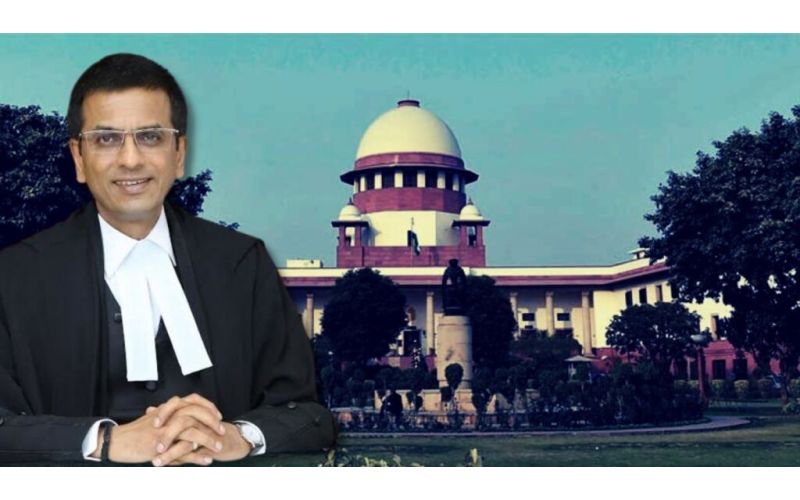
NEW DELHI: Chief Justice of India DY Chandrachud batted on Friday for adopting and encouraging mediation, including online mediation, as a mode of dispute resolution other than litigation, saying it would reduce the courts’ caseload and has the potential to portray justice as collaborative rather than adversarial.
The CJI said it would especially come to the aid of women from marginalised communities as mediation makes law less “intimidating” and less “alienating”.
He added that when the government, which is the biggest litigator but must “adopt the robes of a friend”, opts for this process, a message is sent that the government itself is not an adversarial opponent.
Justice Chandrachud was speaking at the inaugural session of a national conference on “Mediation at the Dawn of Golden Age”, organised by Samadhan at the Delhi High Court.
Samadhan or the Delhi High Court Mediation and Conciliation Centre was established in May 2006 to provide mediation as an appropriate method of alternate dispute resolution.
During the session, the high court signed a memorandum of understanding with the Uttarakhand High Court in relation to expanding the mediation process in the hill state.
“We stand at the dawn of the golden age of mediation.
Mediation should not be considered as just an alternate dispute resolution mechanism,” the CJI said.
“Mediation offers citizens a forum to not only determine the outcomes of their disputes, but also determine the criteria and standards by which those outcomes are evaluated..
Mediation holds the potential to change the way we understand justice itself — from an adversarial, formal process to a more collaborative, interest-based process.
In other words, mediation is much more than a movement to de-clog the courts,” he said.
Justice Chandrachud said the government of India will benefit from strategically adopting online dispute resolution mechanisms.
The event was attended by Justice Sanjay Kishan Kaul of the Supreme Court, Delhi High Court Chief Justice Satish Chandra Sharma, other high court judges, including Justices Manmohan and Sanjeev Sachdeva, Attorney General (AG) R Venkataramani and several other dignitaries.
In his address, Venkataramani announced that he has proposed to set up the “Attorney General’s National Council of Mediator’s Watch” as well as the “Attorney General National Award for Mediation Achievers” to encourage the practice.
He also favoured strengthening private mediation in the country.
Justice Kaul, who recollected the top court appointing a mediation panel in the Ayodhya dispute, said the mindset of choosing mediation for dispute resolution should be encouraged as the process gives the parties autonomy and “innovative solutions”.
He also urged the AG to use his good office to see that the mediation bill, pending before Parliament, “sees the light of the day” soon.
“The litigant wants a solution.
He does not want legal jargons,” Justice Kaul said as he highlighted that mediation was provided as a mode of dispute resolution in various laws, such as commercial courts law, consumer law as well as real estate law.
In his presidential address, Justice Chandrachud also said the process of mediation “preserves the ongoing relationship” between parties but has certain “inequities”, such as the scope of the mediators’ role.
“Mediation is seen as a means of serving the rule of law.
The transformative characteristic of mediation is that it is a process which puts the decision-making authority in the hands of ordinary people, empowering the people involved in the dispute,” he said.
“Women, especially those belonging to marginalised communities, have often found formal legal proceedings to be alienating, having been historically prevented from accessing law on an equal footing.
To mitigate this alienation, dispute resolution mechanisms, such as mediation, where parties express their grievances directly, take a step forward in making the law less intimidating,” the CJI added.
He further said mediation can help the young become active listeners and stretch their “short attention spans”, which is a serious problem today, and thus, emphasised on imparting mediation skills to them.
“I often say that as judges, we need to be careful that when we judge others because that is our job, we must do so without being judgmental of others.
In a similar vein, for all mediators out there, I would advise everyone to borrow a life lesson from the OTT football coach — Ted Lasso — ‘be curious, not judgmental’,” Justice Chandrachud said..
Read Source