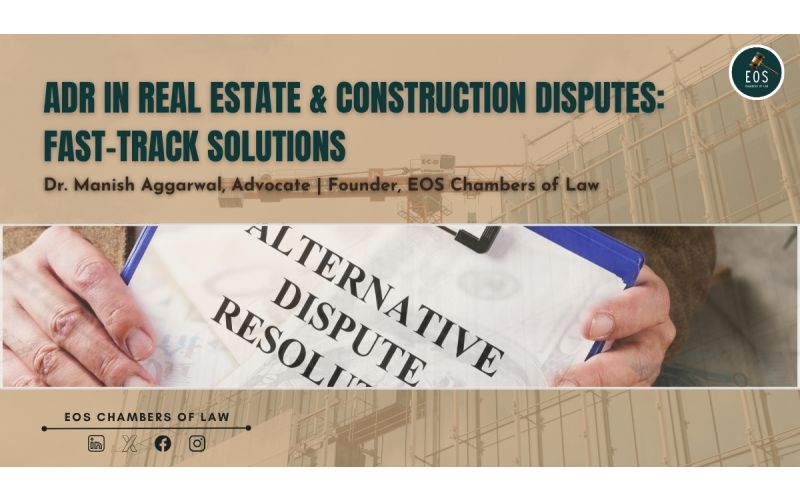
The real estate and construction sector in India is one of the fastest-growing industries, but it is also one of the most dispute-prone. Delays in possession, payment disputes, contractor disagreements, quality issues, and non-compliance with project timelines often lead to conflicts between builders, contractors, homebuyers, and investors.
Traditional litigation in such matters can take years — causing huge financial losses and project delays. This is where Alternative Dispute Resolution (ADR) becomes a game-changer.
ADR offers faster, more efficient, and cost-effective ways to resolve real estate and construction disputes without getting stuck in lengthy court battles.
Why ADR Works Best for Real Estate & Construction Disputes
1. Speed & Efficiency
Construction and real estate disputes are time-sensitive.
Through arbitration and mediation, most disputes can be resolved within months, not years — helping projects move forward without long legal interruptions.
2. Cost-Effective
ADR avoids prolonged litigation costs, legal fees, and court expenses.
Builders, contractors, vendors, and buyers can all save money while still getting legally enforceable outcomes.
3. Industry Expertise
In construction arbitration, parties can appoint industry experts — engineers, architects, project managers — as arbitrators.
This ensures faster understanding and more accurate decisions for technical disputes.
4. Confidential & Business-Friendly
Unlike court cases, ADR proceedings are private.
This protects the reputation of real estate companies and contractors, and helps maintain business relationships even after the dispute is settled.
5. Flexible & Negotiation-Friendly
ADR allows flexible procedures and encourages negotiated settlements, which help preserve long-term partnerships among stakeholders (builder–contractor, developer–supplier, buyer–builder).
Common Real Estate & Construction Disputes Resolved Through ADR
-
Delay in project completion
-
Quality or material defects
-
Contract interpretation issues
-
Payment disputes between builder & contractors
-
Disagreements over design changes
-
Land acquisition or title-related disputes
-
NRI real estate disputes
-
Refund & possession-related issues for homebuyers
-
Joint venture and partnership disputes in construction
ADR Mechanisms Used in the Industry
🔹 1. Arbitration
Arbitration is the most preferred method in construction matters.
Contracts typically include an arbitration clause, allowing parties to refer disputes to an arbitrator whose decision is legally binding.
🔹 2. Mediation
Mediation encourages dialogue and negotiated settlement, especially helpful in buyer–builder and contractor disputes.
🔹 3. Conciliation & Negotiation
These methods offer even more flexibility and allow parties to settle differences without a formal structure.
Why Builders, Contractors & Homebuyers Should Prefer ADR
-
Faster enforcement of rights
-
Reduced project delays
-
Less adversarial than litigation
-
Customizable procedure
-
Allows business continuity
-
Enforceable awards under the Arbitration & Conciliation Act
Conclusion
Real estate and construction disputes demand quick, practical, and technically sound solutions — making ADR the most effective remedy.
Whether you are a builder, contractor, supplier, homebuyer, or investor, choosing ADR can save time, money, and business relationships while ensuring fair and enforceable outcomes.