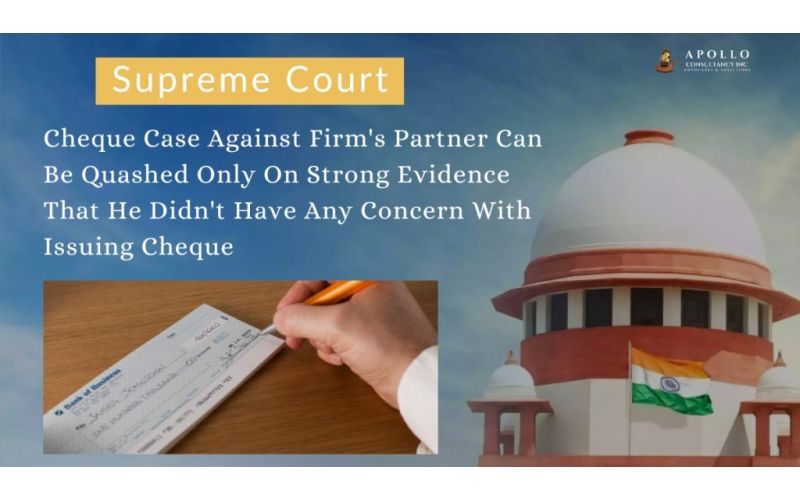
The Supreme Court observed that a cheque case against a partner of the firm cannot be quashed under Section 482 CrPC unless there is unimpeachable and incontrovertible evidence that he/she did not have any concern with the issuance of cheques.
The High Court had quashed the summoning order against a partner of the firm taking into account the materials which indicated that on the dates when the cheques were issued for discharging the liability for payment of rent for the premises taken by the firm, he had already retired from the firm and a Retirement Deed in that regard was executed.
Disagreeing with this view, the Apex Court bench of Justices Hima Kohli and Rajesh Bindal observed that the Retirement Deed sought to be produced by the partner for quashing of the summoning order and the complaints could not be taken on its face value, and treated as clinching evidence to quash the complaints. It is not the case set up by him that in the Partnership Deed it is mentioned that he was a sleeping partner in the firm, the Court noted.
Code of Criminal Procedure, 1973 ; Section 482 – Cheque complaint against partner of a firm – Powers under Section 482 of the Code can be exercised by the High Court in case when it comes across unimpeachable and incontrovertible evidence to indicate that the partner of the firm did not have any concern with the issuance of cheques.
A vacation bench of Justices Sudhanshu Dhulia and K V Vishwanathan said this prerequisite existed earlier as well and it was not inclined to intervene in the matter. New Delhi: The Supreme Court on Monday dismissed a plea challenging the ...
Introduction: Why PE Risk Is a Serious Compliance Issue in 2026 India continues to witness heightened scrutiny of foreign companies operating through subsidiaries, employees, consultants, and digital presence. With increased data sharing, GST intelligence, and income-tax investigations, Permanent Establishment (PE) ...
Chief Justice of India, DY Chandrachud recently spoke on how justice and the outcome of the law depends on who is wielding the law in their hands. When the law is wielded with compassion, it is capable of producing justice, ...
As global business transactions increase, so do the risks of cross-border disputes. When parties from different countries find themselves in conflict, traditional litigation can be slow, costly, and fraught with jurisdictional complexities. This is where Alternative Dispute Resolution (ADR)—specifically, international ...
In a case pertaining to grant of default bail to a person accused under the Unlawful Activities (Prevention) Act, 1967 (“UAPA”), the Supreme Court yesterday allowed an appeal filed by the Delhi police, observing that the High Court fell in ...
The Supreme Court has held that the eligibility condition of minimum 75% marks does not promote the object of introducing the sports quota, and such criterion subverts the object and falls afoul of the equality clause in Article 14 of ...