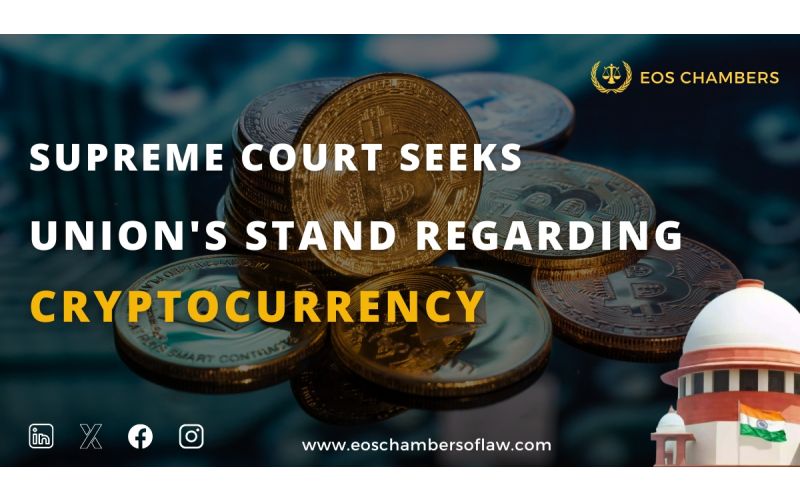
The Centre has told the Supreme Court it is yet to take a decision on a mechanism to regulate cryptocurrencies and effectively investigate related offences. A bench of justices Surya Kant and KV Viswanathan was told by Additional Solicitor General Vikramjit Banerjee, appearing for the Centre, that the issues related to the digital currency are continuously evolving and the government is deliberating on the mechanism to regulate the cryptocurrencies.
He sought time to file an affidavit by the next date of hearing in the case giving updated position on the mechanism."So far as the stance of the Union of India with reference to the matters of cryptocurrency arising in different states is concerned, the Additional Solicitor General of India seeks and is granted four weeks' time to file an appropriate affidavit," the bench ordered on Friday.
During the hearing, Justice Kant said the court only wants that there are appropriate safeguards to protect the common man from frauds and misuse of cryptocurrencies.
"We are not experts on what kind of currencies you should have or regulate. If there is no mechanism to regulate it, then anyone can create a currency and start transacting in it. It will be very dangerous," the bench told Banerjee.
The ASG assured that deliberations are going on but it's an evolving question and he will file an affidavit giving details of it on the next hearing of the matter.
Read more
The Supreme Court has reinstated an award originally granted by the Motor Accidents Claim Tribunal (MACT). The apex court expressed disappointment over the approach taken by the High Court in evaluating the evidence and reinstated the MACT’s verdict. The Court ...
When NRIs (Non-Resident Indians) go through a divorce involving children, legal rights around custody, visitation, and jurisdiction often become complex. Key Points: Jurisdiction Matters: If the marriage was registered in India or the couple last lived here, Indian courts can ...
In a recent case, the Supreme Court reminded police officers of their duty to be vigilant before invoking provisions of stringent laws such as the SC-ST (Prevention of Atrocities) Act, stating that officers must be satisfied that the provisions apply ...
Section 377 of the Indian Penal Code, a colonial-era law, criminalized "unnatural offenses," including consensual same-sex relationships. However, in a historic judgment on September 6, 2018, the Supreme Court of India decriminalized consensual homosexual acts between adults, marking a significant ...
Corporate Social Responsibility (CSR) has evolved from a voluntary initiative to a crucial component of modern business strategy. In today's globalized economy, companies are expected to contribute positively to society while maintaining profitability. However, CSR is not just about corporate ...
📘 Can a Minor Enter Into a Contract? ❌ Absolutely Not.As per Section 11 of the Indian Contract Act, 1872, a person must be of the age of majority (i.e., 18 years or 21 in certain guardianship cases) to enter ...