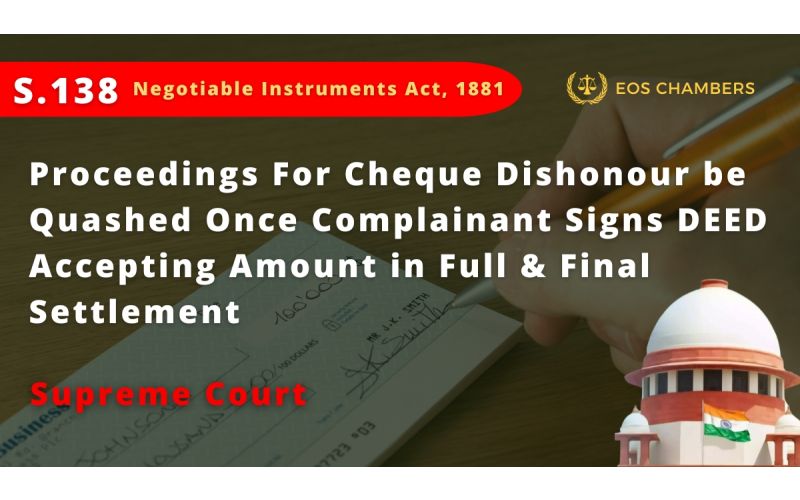
In a Criminal Appeal arising out of proceedings under Section 138 of the Negotiable Instruments Act, 1881, the Supreme Court has ruled that once the settlement has been arrived at and the complainant has signed the deed, the proceedings under this provision must be quashed.
"Considering the overall facts and circumstances of the case, we are of the view that once the settlement has been arrived at and the complainant has signed the deed accepting a particular amount in full and final settlement of the default amount and the fine amount awarded by the Trial Court, the proceedings under Section 138 of the NI Act need to be quashed," observed the bench of Justices Vikram Nath and Satish Chandra Sharma.
The instant appeal was filed challenging the September 13, 2017, order passed by the High Court of Himachal Pradesh, Shimla Bench. By its impugned order, the High Court had upheld the conviction of the accused persons/ the present petitioners under Section 138 of the N.I. Act.
However, in the meantime, a compromise deed was entered between the parties. As per this deed, the respondent-complainant agreed to accept a certain amount as full and final settlement of the cheque amount and the fine imposed by the Trial Court and confirmed by the High Court.
By India, Today News Desk: Justice Prashant Kumar Mishra and senior advocate KV Viswanathan were sworn-in as Supreme Court judges on Friday, a day after the Central government cleared the appointment of the advocates. New Union Law Minister Arjun Meghwal took to ...
Navigating legal compliance is crucial for startups to establish a strong foundation and ensure sustainable growth. In India, understanding and adhering to applicable laws can be complex but essential. Here’s a concise guide to help startups stay compliant: 1. Incorporation ...
The rapid proliferation of digital technologies has transformed India’s social, economic, and professional landscape. While digitalization brings efficiency and innovation, it also exposes individuals and businesses to cybercrime risks. As a lawyer in India, it is crucial to understand the ...
The Supreme Court has said a five-judge constitution bench will examine whether Parliament can “abrogate the constitutional principles of governance” for the Delhi government by making a law to take away its control over services. The Centre recently issued an ...
Alternative Dispute Resolution (ADR) has become a pivotal tool in family law, offering a way to resolve disputes without the need for contentious court battles. At Eos Chambers, we've observed the growing reliance on ADR methods such as mediation, arbitration, ...
Navigating family law matters can be especially challenging for Non-Resident Indians (NRIs) who may face unique legal complexities. Whether dealing with divorce, child custody, or property disputes, understanding your rights and available legal solutions is crucial. Here are some key ...