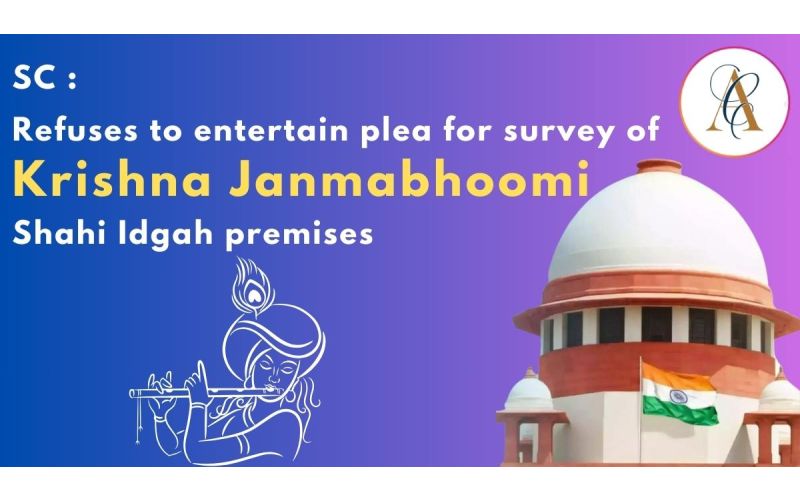
The Supreme Court Friday refused to entertain a plea by 'Shri Krishna Janambhoomi Mukti Nirman Trust' seeking a survey of the Janmabhoomi-Shahi Idgah mosque premises in Mathura to determine whether it was built on a pre-existing Hindu temple. The apex court rejected an appeal challenging a July 10 decision of the Allahabad High Court which had also dismissed the plea finding no error or illegality in the order of a Mathura civil judge who had decided to first hear the issue of maintainability of the mosque.
The Trust challenged an order of the Allahabad High Court which dismissed its plea to direct the Mathura civil judge to decide its application for a scientific survey of Krishna Janmabhoomi-Shahi Idgah mosque premises first before deciding the objections raised against the suit.
The objections against the suit were raised before the civil judge by the management committee of the mosque and the Uttar Pradesh Sunni Central Waqf Board.
"Thus, we feel we are not required to exercise jurisdiction under Article 136 of the Constitution, more so being an interim order, as there are various issues at large which are pending before the high court as the court of first instance," a bench of Justice Sanjay Kishan Kaul and Sudhanshu Dhulia said.
Senior advocate Gaurav Bhatia, representing the Trust, submitted before the apex court that aggrieved by the trial court's March order, they preferred a petition before the high court, which on May 26 transferred all the suits related to the matter to itself.
The bench said it was conscious of the fact that all related proceedings, including the suits, stand transferred to the high court. However, the trial court passed the order before such transfer took place and it cannot be said that it did not have the jurisdiction to pass such an order.
"The high court on transfer of all the cases will do the trial and be the court of first instance. That being the position it cannot be urged, as counsel for the petitioner submits, that the said court alone should have exercised the jurisdiction... also against the order of the trial court," the bench said, adding that the issues related to the suits are to be considered by the high court.
The top court also noted the submission of advocate Tasneem Ahmadi, representing Shahi Masjid Eidgah Management Committee, that a special leave petition (SLP) has been filed by them against the high court's May 26 order which is pending before the apex court.
"Thus what we have observed aforesaid is without prejudice to the rights and contentions of the respondent in that case," the bench said.
Advocate Mehmood Pracha also represented Shahi Masjid Eidgah Management Committee.
In its plea before the top court, the Trust has submitted that Shahi Masjid Eidgah Management Committee is intentionally attempting to seize control of the sacred worship place of the Hindus and preventing it and other devoted followers from practising their religious rituals on the premises.
"The respondent no. 1 (Shahi Masjid Eidgah Management Committee), including their representatives, have been offering prayers (Namaz) on the same premises, using the premises as rest rooms which is considered to be the holy place/worship place for the petitioner.
"The Respondent no. 1 and their representatives are continuously digging and destroying Hindu symbols, temple pillars, and other significant elements of the temple. This has caused considerable damage to the sanctity and cultural heritage of the place," the plea said.
The petition stated that in order to ensure the credibility of the claim put forth by it and the committee regarding the disputed land, it is imperative to carry out a thorough scientific survey.
"This survey will offer empirical data and substantiate the accuracy of their statements, providing a reliable basis for any conclusions or decisions.
"In order to fully comprehend the religious history and the significance of the site in a religious context concerning the land in dispute, a comprehensive investigation and study of its past are essential through proper scientific survey. This in-depth exploration will provide valuable insights into the site's historical importance and its relevance to religious matters," it said.
On July 10, the high court bench of Justice Jayant Banerjee had dismissed the writ petition filed by the Trust, which went in appeal.
In January this year, the Trust had filed a suit before the civil judge, Mathura, along with a map and a request to protect its interest as well as constitutional rights. It requested that the Krishna Janmabhoomi be restored at the place where the Shahi Masjid Idgah currently exists.
However, the management committee of the Shahi Masjid Idgah and UP Sunni Central Waqf Board filed their objections to the maintainability of the aforesaid suit, saying it is barred by the Places of Worship Act, 1991 that says the religious nature of any place of worship cannot be altered from the way it existed on August 15, 1947, the day India achieved Independence.
The Shri Krishna Janambhoomi Mukti Nirman Trust, through its president Ashutosh Pandey, had requested the high court to direct the civil court in Mathura to decide its application for scientific survey first.
The Supreme Court had in August this year refused to stay the Allahabad High Court order allowing the Archaeological Survey of India (ASI) to conduct a scientific survey in the Gyanvapi mosque complex in Varanasi to determine if the 17th-century structure was built upon a pre-existing temple.